Who Sets the Price on Each Line of a Funeral Bill, and Which Lines You Can Cross Out
title:Who Sets the Price on Each Line of a Funeral Bill, and Which Lines You Can Cross Outauthor:Beatrix Stapletonpublished:2025-12-26section:Familywords:1,067read:5 min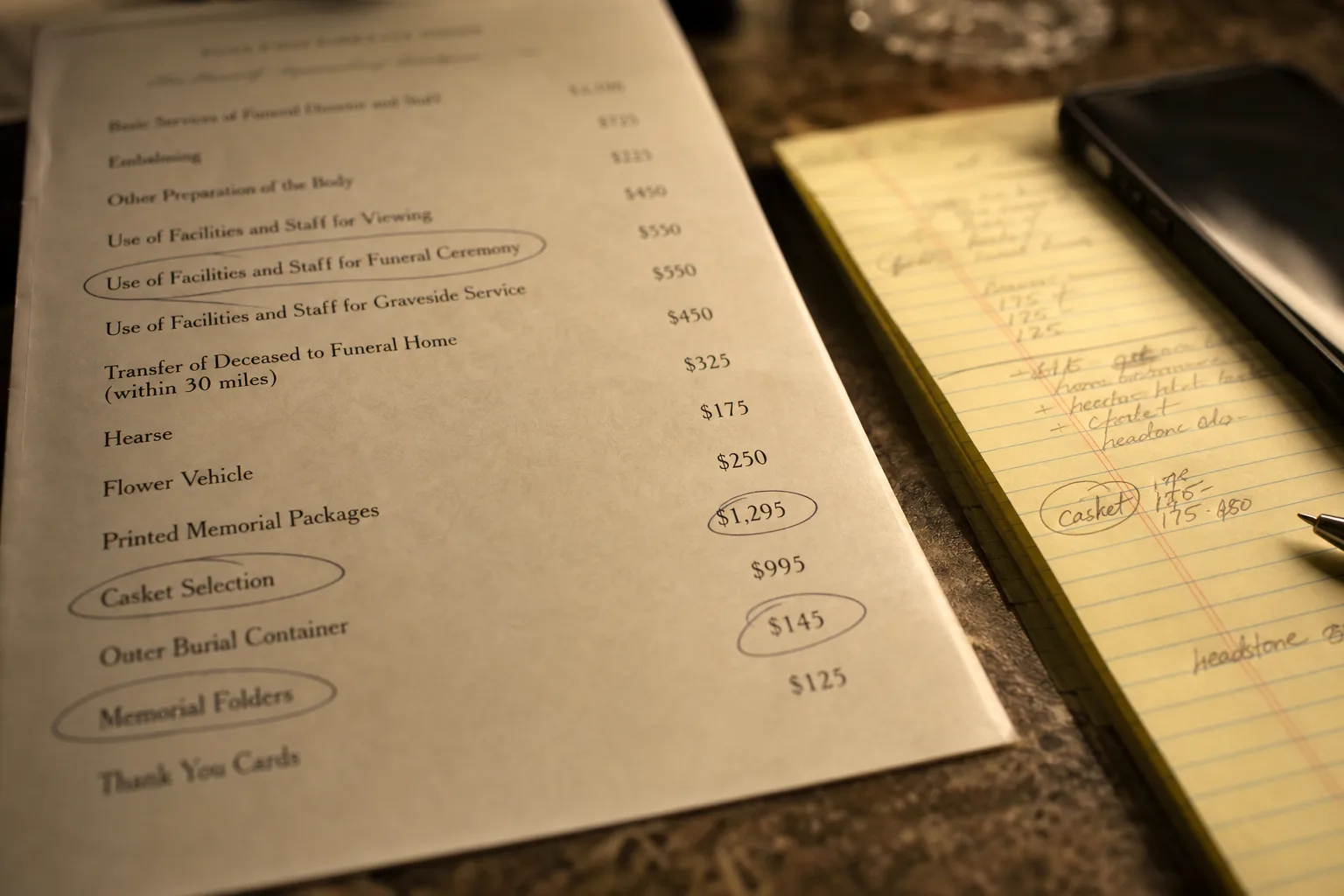
A funeral bill mixes charges the provider sets with charges set by third parties who never speak to you. Sorting the two is where the money is.
A funeral bill looks like one document from one business. It is not. It is a stack of charges from several parties, only one of which is standing across the table from you, and the split matters because your leverage is completely different on each side of it. The provider sets its own service and merchandise prices and competes on them. The cemetery, the crematory, the county registrar and the newspaper set theirs and do not care which funeral home you picked. Learning which line belongs to whom is the fastest way to cut a number that feels fixed.
Ask for the itemized list before anyone shows you a package
Every funeral provider that sells to the public is required to hand you a printed, itemized price list when you sit down to discuss arrangements, before the merchandise room, before the casket display, before the brochures. That document is the whole basis of the conversation. It lists each good and service separately with a price next to it, and you are entitled to buy only the items you want.
Packages are not forbidden and they are sometimes a real discount. But a package priced against an itemized list is a claim you can check, and a package quoted with no itemized list beside it is not. When you have the list, work down it and mark three things: charges the provider itself sets, charges it is passing through from somebody else, and the one line you cannot decline.
That non-declinable line is the basic services fee. It covers the provider's overhead and the work that happens no matter what you choose: coordination, staff availability, permits and filings, the record keeping. It gets added to any arrangement, so when you compare two providers, compare that fee first. It is the single number that follows you through every other choice.
The party most families never notice: the third parties billed through the funeral home
Somewhere on the statement there will be a group of charges under a heading like cash advances, advance items, or accommodations. These are amounts the funeral home pays out on your behalf to businesses and agencies that are not the funeral home. Typically they include the crematory fee, cemetery charges for opening and closing the grave, certified copies of the death certificate, the obituary placement, flowers, clergy or celebrant honorarium, musicians, and sometimes police escort or out-of-town transfer.
These are the people in the room nobody looks at. The grave opening is priced by a cemetery superintendent working from a fee schedule the cemetery board approved. The certified copies are priced by a county or state vital records office and the fee is statutory, identical whichever funeral home orders them. The obituary is priced by a newspaper's classified desk by the line or the inch. None of those parties negotiated with your funeral director.
Two things follow. First, a provider that adds a service charge or markup to any advance item, or that gets a rebate or discount it does not pass on, has to disclose that in writing. Ask directly whether the advance items are billed at cost. Second, most of them you can simply buy yourself. Call the cemetery office and get its fee schedule. Call the vital records clerk and ask the per-copy fee and how many copies banks and insurers in your state usually want. Place the obituary with the paper. Handing the funeral home a shorter list of advance items is not rude and it is not unusual.
Sort the list by who sets the price
| Charge | Who sets it | Can you decline or source it elsewhere? |
|---|---|---|
| Basic services fee | The funeral provider | No, but it varies widely between providers |
| Embalming | The funeral provider | Usually yes; rarely required by law, and cannot be billed without permission |
| Casket, urn, outer burial container | Provider sells it, but you may buy elsewhere | Yes, and no handling fee may be charged for one you supply |
| Viewing, ceremony, staff at graveside | The funeral provider | Yes, item by item |
| Transfer of remains, hearse, limousine | The funeral provider | Hearse and limousine are separable choices |
| Crematory fee | The crematory operator | Pass-through; ask what the crematory charges |
| Grave opening and closing, liner requirement, marker setting | Cemetery management | Fixed by the cemetery, not the funeral home |
| Certified death certificate copies | County or state vital records office | Statutory fee; you can order them yourself |
| Obituary, flowers, clergy honorarium, musicians | Newspaper, florist, individual | Yes, arrange direct |
Use the phone the way the rules assume you will
The Federal Trade Commission oversees funeral pricing disclosure in the United States, and the protections it administers are built around the assumption that families shop. A provider has to give you prices over the telephone if you ask, without requiring your name or address first, and has to answer specific questions about what individual items cost. That is a real tool and almost nobody uses it in the week it would help.
Call three providers with the same short script: the basic services fee, the direct cremation price, the immediate burial price, the transfer charge, and whether advance items are billed at cost. Write the five answers in a column. You will usually find the spread lands in the provider-controlled lines, because the pass-through lines are the same for everyone in the county.
Get the written statement and read it against your own list
Before you pay, you are owed an itemized written statement of everything you selected, with the total, delivered at the end of the arrangement conference. It should also cite any legal or cemetery requirement being used to justify an item, in writing. That last part is quietly powerful: it turns "the cemetery requires a liner" into a line you can verify with the cemetery office.
Check the statement against your own marked-up price list, item by item, and check the advance items against the numbers you gathered by phone. Discrepancies at this stage are ordinary and usually clerical, and they get fixed on the spot when you point at them.
Families who do this tend to spend on the parts they actually wanted: the visitation, the marker, the reception afterward. The savings come out of the lines nobody in the family would have remembered a year later, and out of pass-through charges paid direct to the clerk, the cemetery office and the newspaper desk who set those prices in the first place.