Hurt in a Crash and Not Sure It Needs a Lawyer? Work It Week by Week
title:Hurt in a Crash and Not Sure It Needs a Lawyer? Work It Week by Weekauthor:Lionel Karstenspublished:2026-11-12section:Law & Legalwords:1,275read:5 min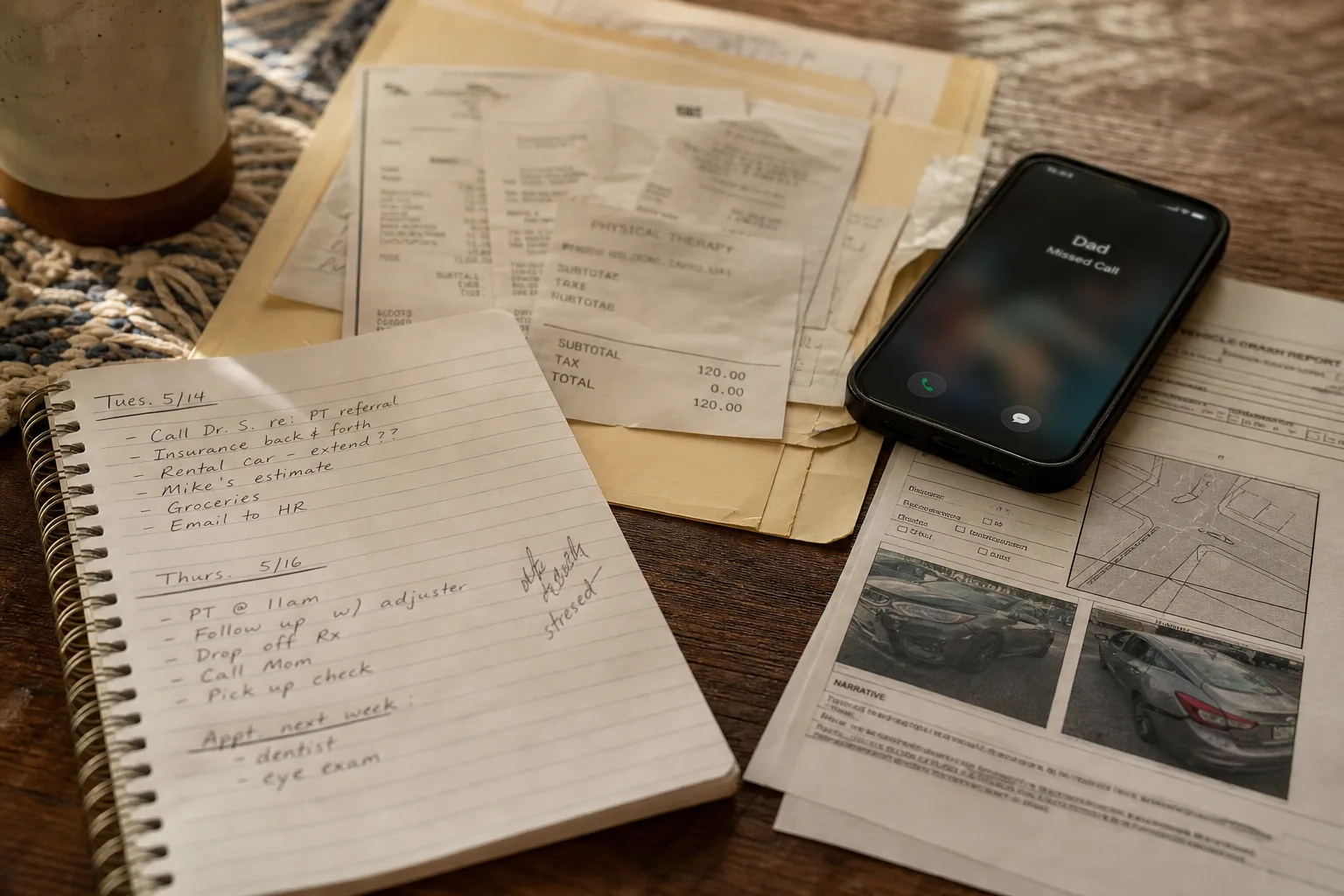
Most injury problems resolve themselves or escalate within about six weeks. Here is what separates a file that is handled well from one that is merely opened.
The decision almost nobody makes well is the one made on day two, in a parking lot, with a sore neck and a phone full of voicemails. People either call a law office immediately because a billboard told them to, or they decide they are fine and handle it themselves because the other driver apologized. Both are guesses. The useful version of this decision is not made on day two at all. It is made over about six weeks, by watching three things change: what your body does, what the insurer does, and whether anyone is still disputing who caused it.
I spent years on job sites where the difference between a finished job and a passable one was invisible from the street. Legal help works the same way. Two files can produce the same settlement number and one of them was handled properly while the other just got lucky with a reasonable adjuster.
Week one: the file is built or it is not
Nothing legal happens in week one. What happens is documentation, and this is the part that gets skipped when nobody is watching, because it is boring and because you feel fine enough to skip it.
A properly built first week looks like this. You have the crash report number, not a promise that one exists. You have photographs of both vehicles and of the scene itself, including the sightlines, not just the dent. You have names and phone numbers for anyone who stopped. You have seen a doctor or an urgent care clinic and said out loud every part of you that hurts, including the parts you think are nothing, because the record of what you reported on day three is the record that matters in month seven. You have a notebook or a note on your phone where you write, once a day, what hurt and what you could not do.
A barely adequate first week has photos of the bumper, a report number you never confirmed, and a visit to a doctor where you said "a little sore" because you did not want to seem dramatic.
You do not need an attorney to do any of this. You do need it done, and a lawyer who joins in month three cannot retroactively create a week one that did not happen. That is the entire reason some files are worth less than they should be.
Weeks two and three: the signals that mean handle it yourself
Plenty of collisions do not need counsel, and a decent attorney will tell you so on the phone. The clear self-handle pattern runs about like this:
- Liability is not in question. The other carrier has accepted fault in writing or in a recorded statement you have the reference number for.
- Property damage only, or injuries that resolved inside a couple of weeks with no imaging and no referral.
- Total medical bills are small and fully known. Nothing is still open.
- You missed little or no work, or your employer paid you anyway.
- The adjuster is returning calls and the numbers being discussed are inside the range your own reading suggests is normal.
Under those conditions, paying a third of a settlement to recover a bill that was going to be paid regardless is a poor trade. Handle it. Keep the receipts, read the release before you sign it, and understand that signing closes the matter permanently.
The week-by-week tells that change the answer
The reason to judge this over weeks rather than at the scene is that the three variables move independently, and any one of them crossing a line is enough.
| What you are watching | Handle it yourself | Get counsel involved |
|---|---|---|
| Medical course | Improving on schedule, discharged | Referral to a specialist, imaging ordered, symptoms still changing after four weeks |
| Fault | Accepted, in writing | Disputed, split, or "still under investigation" past week three |
| Insurer behavior | Calls returned, bills paid as submitted | Pressure for a recorded statement before treatment ends, early lump offer, silence |
| Lost income | None, or covered | Time off that is accumulating, or work you can no longer do the same way |
| Who else is involved | Two private drivers | A commercial vehicle, a government vehicle, an uninsured driver, or your own carrier |
The early lump offer deserves its own note. An offer that arrives before you have finished treating is not generosity and it is not an insult. It is a priced bet that your medical course is finished. If you know it is finished, take the money. If a doctor has you coming back, that offer is the signal to stop negotiating alone.
Workplace injuries follow a separate track, and the recordkeeping obligations that sit with your employer are overseen by the Occupational Safety and Health Administration. If you were hurt on the clock, the question is not only whether to hire someone but which system you are in, and those two systems have different deadlines.
What a good job looks like once counsel is involved
Most people evaluate a law firm on the intake call, which is the one part of the process designed to be pleasant. The parts that actually separate good work from adequate work show up in weeks four through fifty, and they look like this.
You know the name of the person doing the day-to-day work on your file, and it is not always the attorney. Someone tells you, before you ask, what is outstanding: which records have not arrived, which lien has not been resolved, which bill is sitting unprocessed. The medical liens are worked down rather than simply subtracted from your check at the end, because the difference between a lien negotiated and a lien paid in full is often a larger share of the outcome than the gross settlement number. You are told the statute of limitations for your state and your type of claim at the start, not when it becomes urgent.
You get a settlement breakdown you can follow line by line: gross, fee, case costs itemized, each lien named with the amount originally claimed and the amount actually paid, and your net. If you ask what a case cost was for and the answer is vague, that is the tell.
Where you are matters too, because filing deadlines, comparative fault rules and the way local adjusters price a file are all state-specific, which is why a case arising on an Oklahoma highway is better handled by a personal injury attorney in oklahoma than by a national intake center that routes it somewhere else.
Three questions worth asking before you sign anything
- Who handles my file day to day, and how often will I hear from that person when nothing has happened?
- How are case costs handled if the case does not resolve, and are they deducted before or after the fee is calculated? The order changes your net.
- What is the deadline that applies to my claim, and is there an earlier notice requirement because of who is involved?
Ask those three and you will learn more in ten minutes than from an hour of reassurance. A firm that answers them plainly, including the part about costs, is a firm that expects you to read the breakdown at the end.
The honest test, six weeks out, is whether you can still describe your own case accurately: what hurt, what it cost, who agrees it was not your fault, and what is still open. If you can, you are probably fine on your own. If you cannot answer one of them, that gap is the job, and it is cheaper to hand it to someone in week six than in month six.