A Maple on the Property Line, Ten Years Apart. What Changed in How the Job Gets Decided
title:A Maple on the Property Line, Ten Years Apart. What Changed in How the Job Gets Decidedauthor:Lionel Karstenspublished:2026-11-11section:Propertywords:1,069read:5 min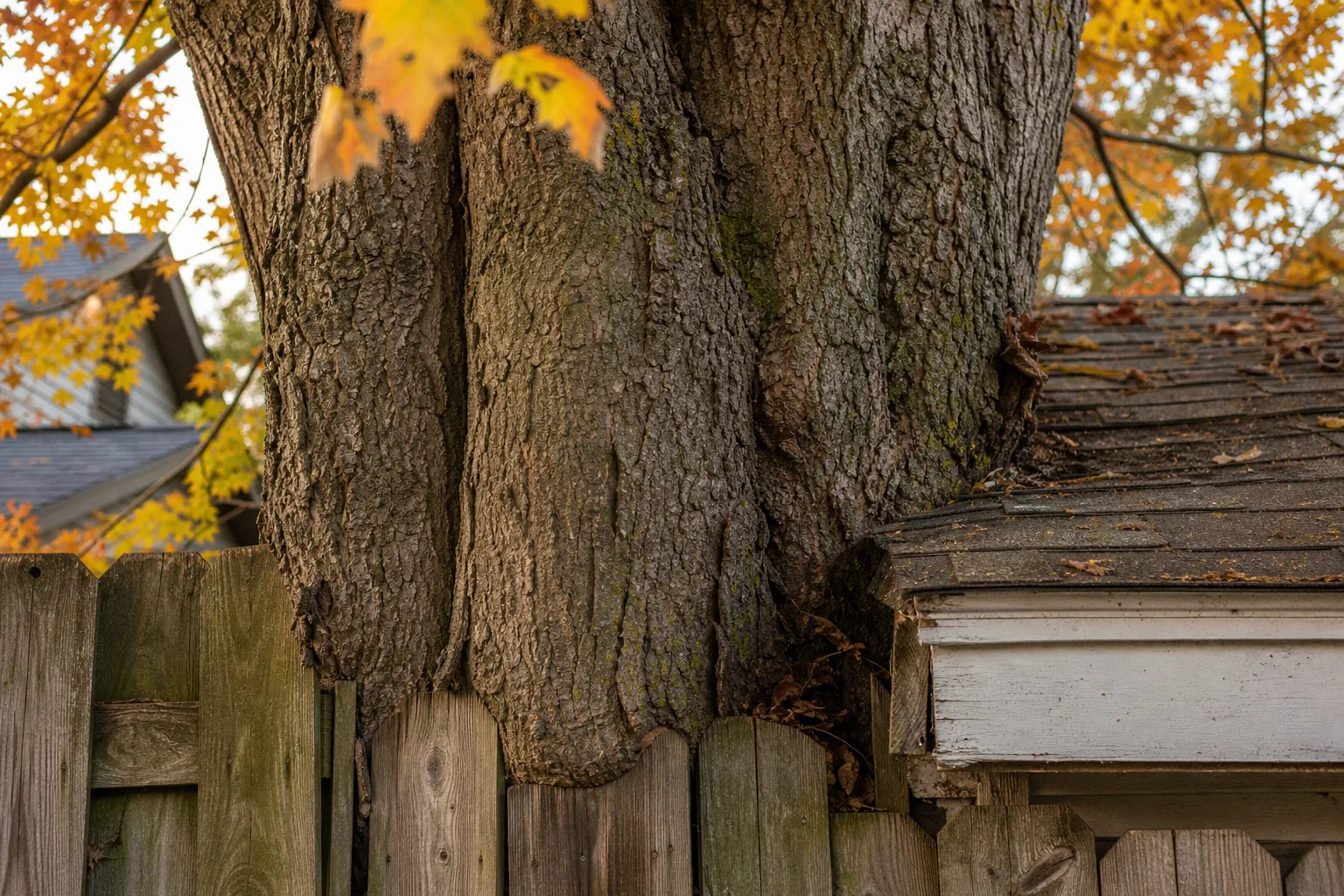
The same boundary tree, the same two neighbors, a decade between decisions. What changed was not the tree. It was who documented the job and what they wrote down.
The tree was a silver maple sitting roughly on a line between two lots, close enough that the trunk flare pushed into both yards and nobody could say from the ground which side the stem center fell on. One neighbor wanted it gone. The other liked the shade. Ten years later, the same species, the same posture, the same two parcels, and the decision got made a completely different way. Not because the law shifted much. Because the people doing the work started writing things down.
The 2014 version: a handshake, a chainsaw, and no paper
Here is how that job actually went the first time. A two-man outfit showed up in a pickup with a chipper on a ball hitch. The owner who wanted the work done walked the yard with them for about four minutes. The quote was verbal, confirmed by text, and covered "removal and haul, stump extra." Nobody measured the trunk. Nobody pulled a plat. Nobody knocked on the other door.
The part that got skipped, and it gets skipped constantly, was establishing where the stem actually sat relative to the boundary. On most jurisdictions' reading, a tree whose trunk crosses a property line is owned jointly, and one owner cutting it down without the other's agreement is exposed to a damages claim that can be a multiple of what the removal cost. The crew was not in a position to know that and had no reason to raise it. They cut what they were pointed at.
In that case, the maple stayed. The second neighbor came out mid-setup, there was a conversation on the driveway, and the crew packed up and billed a trip charge. The homeowner who called them had spent money and gotten nothing, and the relationship across the fence took a year to recover. The tree was pruned by somebody else eighteen months later on a quote that nobody compared to anything.
What a larger provider does differently before anyone climbs
The same property, same species, a decade on. The homeowner called a company with multiple crews, a staffed office, and certified arborists on payroll rather than subcontracted per job. The sequence that followed is the actual difference, and it happens before a saw comes off the truck.
- A site visit with a written assessment. Species, diameter at breast height, condition of the crown, visible decay indicators, root plate, lean, and target zone. Photographed.
- A boundary question asked out loud. Not a legal opinion. A note on the estimate reading that the stem appears to sit on or near the line and that written consent from the adjoining owner is required before scheduling.
- Scoped alternatives. Full removal, crown reduction, deadwooding, and a cabling option, each priced separately rather than presented as one number to accept or refuse.
- Insurance and credentials supplied unasked. General liability and workers' compensation certificates, naming the homeowner, sent with the proposal.
- A traffic and drop plan. Where the crane or bucket sits, which beds get boarded, whose driveway gets used.
None of that is exotic. It is what an organization with an estimator, a scheduler and a claims history does because an informal job that goes wrong costs it more than the job earned. A two-man crew absorbs that risk personally and often prices as if the risk is zero.
The two decisions side by side
| Element | Ten years ago | Now, with a staffed provider |
|---|---|---|
| Assessment | Visual, from the ground, unrecorded | Written, photographed, by a credentialed arborist |
| Boundary question | Not raised | Flagged on the estimate as a condition of scheduling |
| Neighbor's role | Discovered mid-job | Countersigned consent before a date is set |
| Options presented | Removal, or nothing | Removal, reduction, deadwood, cabling, each priced |
| Insurance proof | On request, sometimes | Certificates attached to the proposal |
| Crew safety practice | Variable, unsupervised | Documented procedure, trained climbers, rigging plan |
| What the price covers | Cutting and hauling | Cutting, hauling, overhead of the above |
The second column costs more per job. That is the honest trade. What it buys is a decision you can defend if the neighbor's position changes later, and a crew that does not improvise over a fence line with a 300-pound limb on a single rope. Occupational Safety and Health Administration standards cover how tree care work is performed and how climbers and ground crews are protected, and the practical difference between a company that trains to those requirements and one that does not shows up in rigging, not in the brochure.
How the second case closed
The arborist's report said the maple had codominant stems with included bark and a developing crack at the union, with the heavier stem oriented over the neighbor's garage. That changed the conversation entirely. It was no longer one owner's preference against another's. It was a documented defect over a structure, which is the ground on which a reasonable neighbor says yes.
Both owners signed the same proposal. They split the cost, not evenly: the neighbor with the garage underneath paid the larger share by agreement, because the report made clear who carried the exposure. Scheduling went through the office, the crew arrived with a crane for the overhanging stem rather than freefall-dropping it, and the stump was ground to twelve inches with the grindings hauled rather than raked into a bed. The whole thing took a day. Homeowners comparing tree removal services should ask for the written assessment first and treat the price as the second question, because the assessment is what the neighbor will read.
What to carry into your own version of this
If the trunk is anywhere near the line, settle ownership before you settle on a contractor. A plat from your closing file, or a surveyor for a few hundred dollars, resolves in an afternoon what a dispute resolves in months. If the tree is clearly yours but the canopy overhangs, you still want the drop zone agreed in writing, because the damage that gets argued about is almost always to a fence, a shed roof, or a planting bed on the other side.
Then ask the estimator a direct question: what happens on this job if the neighbor objects on the morning of. A company with a process has an answer ready, and it is usually that the job does not start. That answer is worth paying for.
The maple is gone, the garage is intact, and the two households still speak. The report did that, not the saw.