Water in the House at Ten at Night? Three Routes, and the Technician Whose Notes Decide the Bill
title:Water in the House at Ten at Night? Three Routes, and the Technician Whose Notes Decide the Billauthor:Beatrix Stapletonpublished:2026-11-14section:Propertywords:1,284read:5 min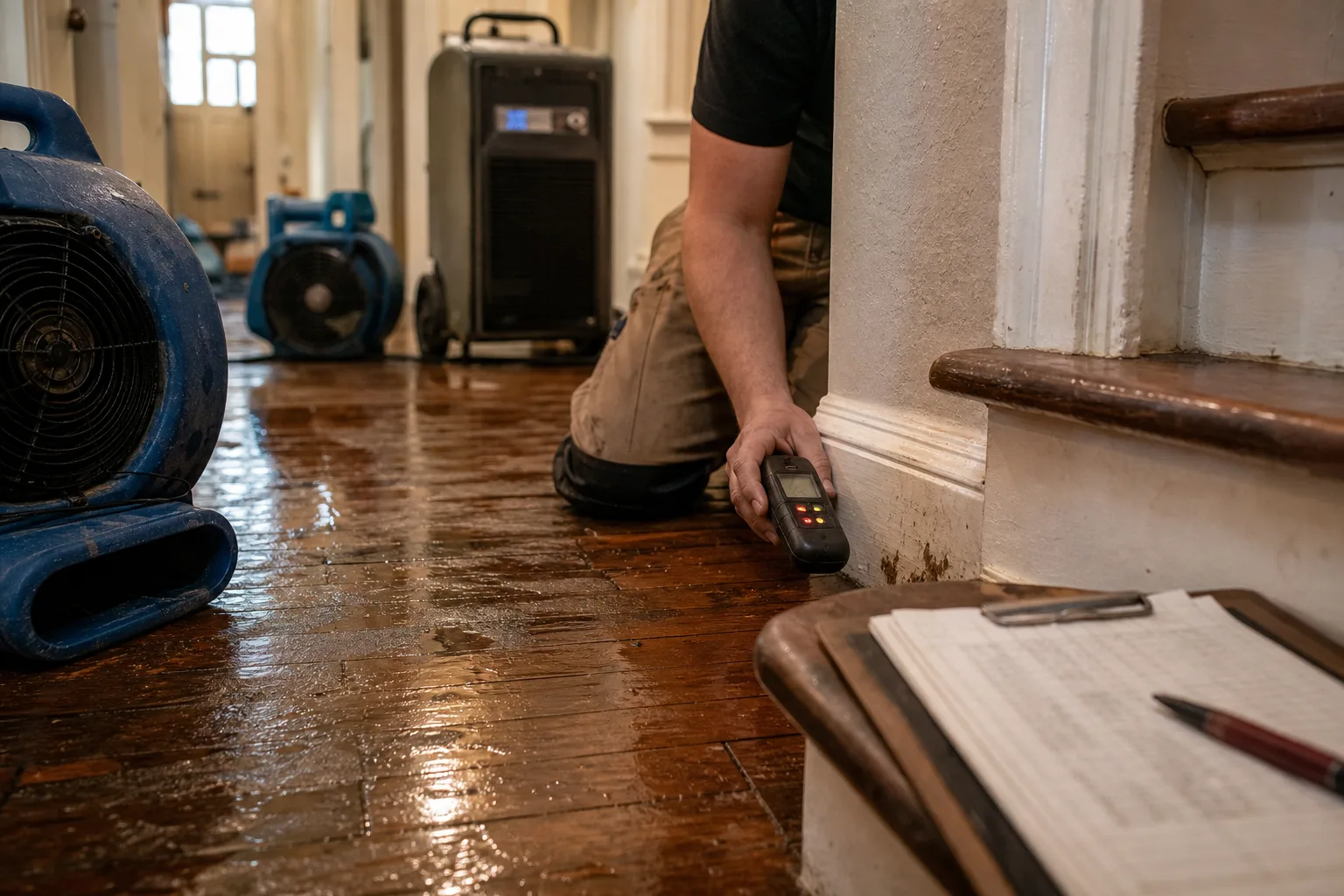
Three ways to handle the first forty-eight hours after water damage, and why the drying technician's moisture log carries more weight at settlement than anyone expects.
The decision gets made at an unreasonable hour, usually by someone standing in a sock that has gone cold. A supply line let go, or a drain backed up, or a roof gave way in a storm, and the house is now a job site. What happens in the next two days determines not just how much drying equipment ends up in the hallway, but how much of the invoice gets paid and who argues about the rest.
There are three practical routes. They differ less in the physical work than in who controls the paperwork, and the paperwork is where the money is decided.
The three routes, side by side
Every route starts with the same two physical steps: stop the water, and get standing water out. After that they diverge.
| Route | Who you call first | Who sets the price | Who owns the documentation | Where it usually goes wrong |
|---|---|---|---|---|
| Insurer's managed repair program | The claims line | Insurer, via a pre-negotiated schedule | The vendor, who reports into the insurer's system | Scope disputes are internal to a system you are not inside |
| Independent restoration contractor you choose | A firm you found or already knew | The contractor, reviewed later against a pricing database | The contractor, who sends you copies if asked | Invoice gets audited line by line weeks after the equipment is gone |
| Self-mitigation, then a claim | Your own wet vac and fans | You, for the receipts you keep | You, entirely | Unverified drying, and a later moisture finding you cannot date |
None of these is wrong. The managed repair route is fastest to mobilize and leaves the least friction over payment, because the price was agreed before your loss existed. The independent route gives you a contractor who answers to you. Self-mitigation is genuinely appropriate for a small, clean-water event caught within minutes, and the cost of that route is almost entirely your own weekend.
The person nobody introduces themselves to
Somewhere in hours four through twelve, a technician walks the affected rooms with a pin meter and a thermo-hygrometer. They write down readings in rooms that are not visibly wet, because those readings establish a dry standard: the moisture content of unaffected material of the same type, which is the target the drying is measured against.
That person is not the adjuster. They are frequently not the salesperson who signed you up. They may be twenty-three years old and working the second of three calls that night. Their notes become the spine of the file.
Here is why. When the invoice is reviewed, and on any loss of consequence it will be reviewed, the reviewer is not looking at your house. They are looking at a drying log and asking whether the equipment count and the number of days are supported. Six air movers for five days in a bathroom is a question. Six air movers for five days in a bathroom where the initial reading on the subfloor was high, the dry standard was recorded, and daily readings show a descending curve is an answer. The technician decides, by what they bother to write down, which of those two documents arrives on the reviewer's desk.
Ask them three things while they are still in the house. What category is this water. What class is the intrusion. What is your dry standard for each affected material. Anyone trained properly will answer without hesitation, and the act of asking tends to produce better notes.
The standards that are already in the room
Water restoration has a published consensus standard, and the trade refers to it constantly: the IICRC S500, which defines the category of water (clean, gray, contaminated), the class of intrusion (how much material is wet and how absorbent), and the documentation expected during drying. Certification under it is voluntary. It is also the yardstick an insurer's reviewer, and later any attorney, will reach for when deciding whether the work performed was reasonable.
The Environmental Protection Agency is the federal body responsible for guidance on mold and indoor air quality in buildings, and its general position on wet building materials is the one everybody in the chain is working backward from: dry quickly, and the mold conversation does not start. The practical window is short. This is why a contractor who arrives with meters at midnight is worth more than one who arrives with sympathy at noon the following day.
Two more rules apply to you directly, and they are in your policy rather than any standard.
- The duty to mitigate. You are required to take reasonable steps to prevent further damage. Shutting the valve, lifting rugs, moving furniture off wet carpet, and calling someone qualified all satisfy it. Waiting four days for the adjuster before touching anything does not, and the additional damage from that wait is the part an insurer can decline.
- Duties after loss. Prompt notice, a reasonable opportunity for the insurer to inspect, and cooperation with the investigation. Keep damaged material, or at least a sample of it, and photograph everything before it leaves the house. The failed supply line itself should go in a bag, labeled, in the garage.
What you sign in hour one
The document put in front of you at the door is rarely just an authorization to work. Read for three clauses.
A direction to pay instructs your insurer to pay the contractor directly. That is often convenient. An assignment of benefits goes further and transfers your rights under the claim to the contractor, who can then negotiate, and sometimes litigate, in your place. Several states regulate or restrict these, and some policies require the insurer's consent. Know which one you are signing.
Then look for the cancellation terms and the equipment rental rate. Air movers and dehumidifiers bill per unit per day. A line that lets equipment sit for an extra forty-eight hours after the dry standard is reached is a line you will see again during bill review.
And note the mortgage angle, which surprises people. On a larger loss, the check may be issued jointly to you and your mortgage servicer, who will endorse it in stages against inspections of the repair work. That is a party with a legal interest in your house who was never in the room, and the first forty-eight hours is when to find their loss draft department's phone number, not the week the check arrives.
Picking a route without regretting it
If speed matters more than control, and the loss is straightforward, the managed repair program removes most of the argument before it starts. If the loss is unusual, or involves hardwood, cabinetry, or anything custom, an independent contractor who works for you is worth the later invoice scrutiny. If the water was clean, the area is small, and you caught it inside an hour, dry it yourself, photograph it obsessively, and keep a meter reading or two of your own on a dated phone photo.
Whichever you pick, the file you end up with looks the same: dated photographs before anything moved, a moisture log with a dry standard, the equipment count and the days it ran, the failed component in a bag, and the name and certification of the technician who took the readings. That last item is the one most people never write down, and it is the one that settles arguments.
Get the name. Ask for the daily log by email as it is created rather than at the end. A technician who knows the homeowner is reading the readings writes better readings, and six weeks later, when a reviewer three states away is deciding what was reasonable, those pages are the only version of your house that anyone is looking at.