Reading a Funeral Bill? Half the Money Goes to People You Never Meet
title:Reading a Funeral Bill? Half the Money Goes to People You Never Meetauthor:Lionel Karstenspublished:2026-11-10section:Familywords:1,342read:6 min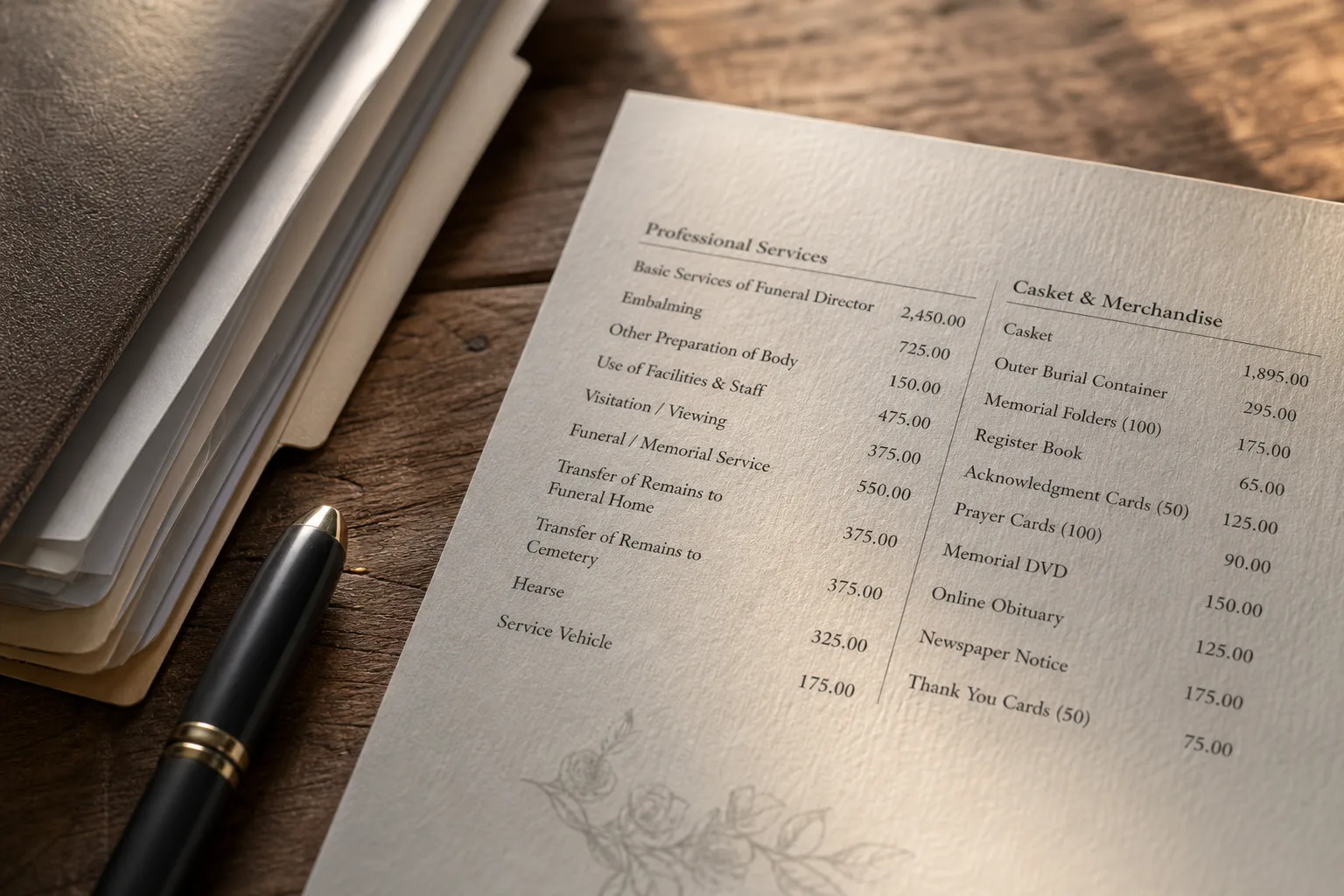
A funeral statement has two halves: what the funeral home does itself, and what it pays third parties on your behalf. Knowing which is which changes what you can decline.
The statement a family signs at the arrangement table usually runs two pages. Most people read the bottom number and the casket line and stop there. The line that deserves the attention is the one headed cash advances, or advance items, or sometimes just sundries. That block is money the funeral home is collecting from you and handing to somebody else. The crematory operator. The county. The cemetery. The vault manufacturer. The newspaper. The person who opens the grave with a backhoe at eight in the morning and is gone before the cars arrive.
Those parties set their own prices and the funeral home has almost no say in them. Which means when a family pushes back on the total, they are often pushing on the half that cannot move, and leaving the half that can.
Two halves of one bill, and only one of them is negotiable
A funeral home sells two different things in the same transaction. The first is its own labor, facilities, vehicles and merchandise: the staff who go out on the removal, the preparation room, the chapel, the hearse, the casket or urn off the display floor. Those prices are set in that building by that owner. They vary enormously between two firms four miles apart, and they are where comparison shopping actually pays.
The second thing is procurement. The funeral home orders the death certificates, pays the crematory, pays the cemetery for the opening and closing, places the obituary, hands the clergy or celebrant their honorarium. On those items the firm is a buyer acting for you. Some pass them through at cost. Some add a service charge for handling them, which they are required to disclose.
The Federal Trade Commission is responsible for the rule that forces this separation onto paper. Under it, a funeral provider has to give you an itemized price list before you choose anything, and has to tell you in writing if it is marking up or receiving a rebate on an advance item. The reason the two halves are printed separately is that they behave differently, and the family is supposed to be able to see which is which.
Who sets each price
| Line item | Who sets the price | Can you decline it? |
|---|---|---|
| Basic services of funeral director and staff | The funeral home | No. This is the one non-declinable fee |
| Transfer of remains to the funeral home | The funeral home (or a contracted removal service) | Only if you arrange it yourself, which few states make practical |
| Embalming | The funeral home | Usually yes. Rarely required by law; often required by the firm for public viewing |
| Refrigeration or shelter of remains | The funeral home | Depends on timing; often the cheaper alternative to embalming |
| Viewing, ceremony, graveside staff | The funeral home | Yes, item by item |
| Casket or alternative container | The funeral home, or any outside seller you choose | Yes, and a firm may not charge you a handling fee for a casket bought elsewhere |
| Crematory fee | The crematory, a separate business in most cases | No, if you are cremating |
| Grave opening and closing | The cemetery | No, if you are burying there |
| Outer burial container or vault | Manufacturer, with the requirement set by the cemetery | The cemetery decides whether one is required; you decide which one |
| Certified death certificates | The county or state registrar | No, but you control how many copies |
| Obituary placement | The newspaper | Yes, entirely |
| Clergy, celebrant, musicians | Them | Yes |
Read down the middle column. In a burial, a large share of the total is set by a cemetery the family chose for reasons that had nothing to do with price, often decades earlier when a plot was bought. In a cremation, a meaningful share is set by a crematory the family will never speak to.
The crematory nobody meets
Most funeral homes do not own a retort. The building, the permit, the emissions controls and the maintenance are a serious capital item, so the common arrangement is a contract with a regional crematory that serves a dozen or more firms. The deceased leaves the funeral home in an unmarked van on a scheduled run, often the same two or three days each week, and comes back the same way.
That batching is why a direct cremation can take a week when the actual process takes a couple of hours. It is also why the price is what it is. The crematory charges the funeral home a trade rate, the funeral home charges you, and the gap between those two numbers is the part that varies by firm rather than by region.
Here is the part of the job that happens with nobody watching. Before the retort, somebody checks the container for a pacemaker or any other implanted battery, because one of those in a cremation chamber damages equipment and people. Somebody confirms the identification tag that will travel through the cycle and come back in the remains. Somebody confirms the medical examiner or coroner has signed the cremation authorization, which in most states is a separate permit from the death certificate and is the reason cremation cannot be hurried the way families expect. Good operators log all three. When you ask a funeral director which crematory they use and whether the remains ever leave their custody, you are asking about the one leg of the process you will never see, and a firm that runs it properly will answer in detail without hesitating.
What actually comes off the bill
Three decisions move more money than everything else combined, and all three sit on the funeral home's half of the page.
- Embalming. No state requires it as a matter of routine. It becomes effectively necessary for an open-casket viewing, for certain transports across state lines, and after a delay. Choose a closed casket or a cremation with a gathering afterward and the preparation room charge, the cosmetics, the dressing and casketing time all come off together.
- Where the gathering happens. Renting the funeral home's chapel and staff for two hours of visitation plus a service is often one of the two largest lines. A church hall, a fire house, a backyard in June: same people, same eulogies, a fraction of the facility charge.
- The container. You may supply your own casket and the firm must accept it without a surcharge. For cremation, the required item is an alternative container, not a casket, and a rental casket with a separate insert exists precisely so a family can have a traditional-looking viewing and still cremate.
What does not come off is the basic services fee. It covers the arrangement conference, the permits, the filings, the twenty-four-hour availability and the overhead behind all of it, and every price list has it.
Three ways to buy the same week
Compare the three common paths not by total but by how many outside parties get involved, because each one adds a price the funeral home does not control.
| Direct cremation, memorial later | Cremation with viewing first | Traditional burial | |
|---|---|---|---|
| Third parties paid | Crematory, registrar | Crematory, registrar, possibly clergy | Cemetery, vault maker, registrar, clergy, often a monument dealer later |
| Funeral home items | Transfer, basic services, container | Adds embalming, viewing, staff, rental casket | Adds embalming, viewing, service, hearse, casket |
| What you still control afterward | Venue, date, catering, scattering or interment | Venue for the later gathering | Marker choice, within cemetery rules |
The first column is not a lesser funeral. It is a funeral in which the ceremony has been unbundled from the disposition, held when the out-of-state family can travel, in a room the family chose. Plenty of firms now sell it as a package and arrange the memorial as a separate service.
Ask for the itemized list before the casket room, not after. Then take a pen to the two pages and mark which side of the line each number sits on. The items set in that building are the conversation. The items set by the crematory, the cemetery and the county are the arithmetic, and knowing the difference lets a family spend the argument where it changes the total.