Three Ways the Same Week Gets Billed, and Which Lines You Can Decline
title:Three Ways the Same Week Gets Billed, and Which Lines You Can Declineauthor:Lionel Karstenspublished:2025-10-23section:Familywords:950read:4 min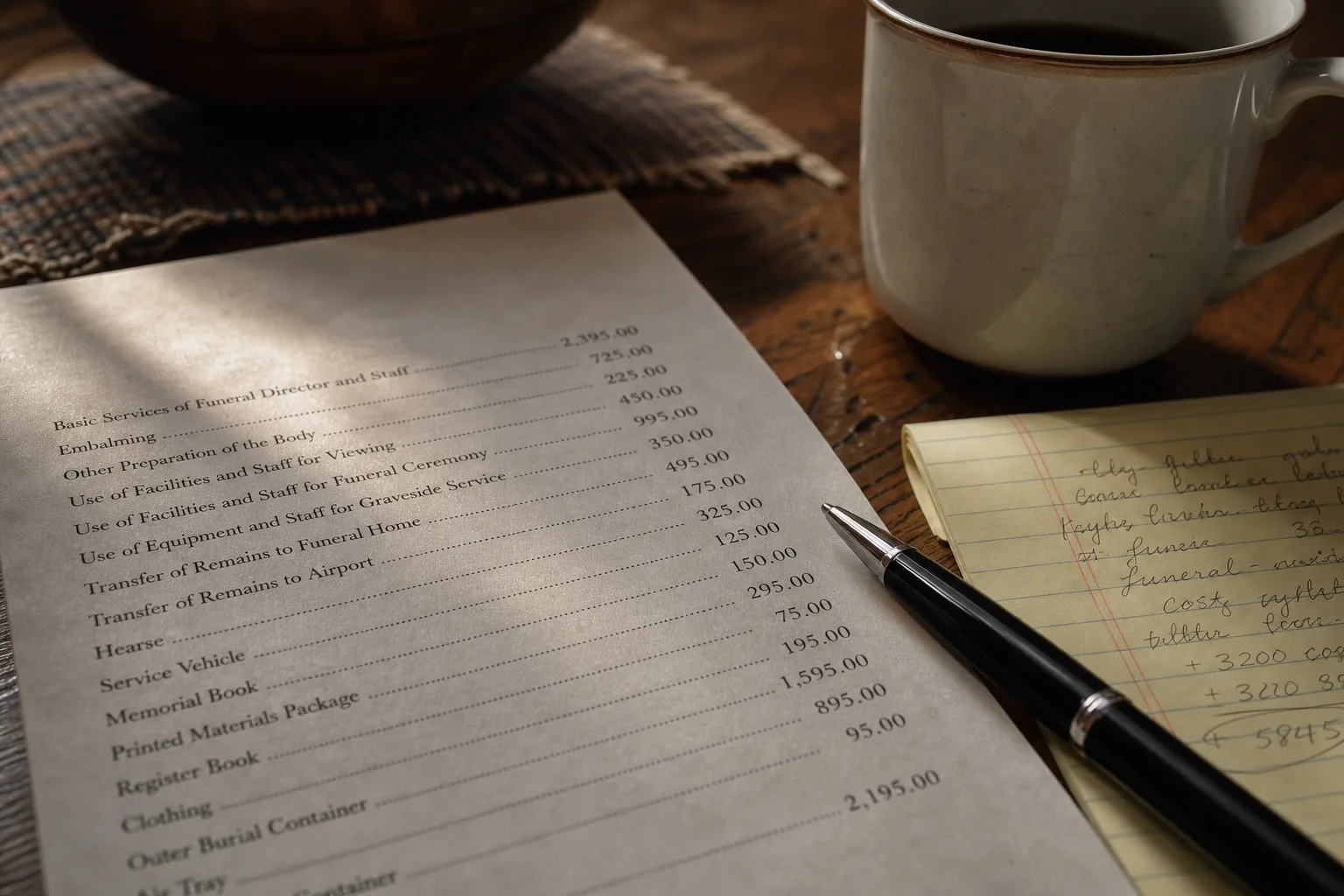
Funeral pricing is built from one nondeclinable fee plus a long list of choices, and the recent shift to online price lists makes the optional part easier to see.
Nearly every funeral bill in the country is assembled the same way: one fee you cannot refuse, plus a stack of items you can. The stack is where the spread between a four-figure bill and a five-figure one lives. Families rarely see it that way at the arrangement table, because the items arrive in the order the home usually sells them rather than in the order you would rank them if you had an afternoon and a calculator.
I spent years on the other side of that table and in the prep room behind it. What follows is how the pricing actually breaks apart, why it is structured this way, and what has shifted recently in how you get to see it.
Why there is a printed list at all
Before the early 1980s, most homes sold packages. You picked a casket and the price of the casket carried everything else: the removal, the staff, the viewing, the hearse. If you wanted less, there was often nothing cheaper to point at. The Federal Trade Commission, which oversees funeral pricing disclosure, changed that with a rule requiring itemized pricing and a written general price list handed to anyone who asks in person about arrangements.
The rule did two things that still shape every bill. It made most items separately declinable, and it allowed one item that is not: a basic services fee covering the home's overhead, staff availability, planning, permits, and coordination. That fee appears on every bill regardless of how simple the arrangement is. Everything else on the page is, in principle, a decision.
The same death, three different bills
Here is the same set of facts, arranged three ways. Dollar figures vary widely by region and by home, so treat the columns as a map of which lines appear, not as a quote.
| Line item | Full-service burial | Direct cremation | Cremation, memorial six weeks later |
|---|---|---|---|
| Basic services fee | Yes, nondeclinable | Yes, nondeclinable | Yes, nondeclinable |
| Transfer from place of death | Yes | Yes | Yes |
| Embalming | Usually charged | No | No |
| Refrigeration or shelter of remains | Sometimes | Often, per day | Often, per day |
| Casket | Yes | Cremation container only | Cremation container only |
| Viewing, staff and facilities | Yes | No | Optional |
| Ceremony staff and facilities | Yes | No | Often held elsewhere |
| Hearse and family car | Yes | No | No |
| Crematory fee | No | Yes | Yes |
| Urn | No | Optional | Optional |
| Cemetery: plot, opening and closing, vault, marker | Yes, billed separately | Only if interring ashes | Only if interring ashes |
| Cash advances: certified copies, obituary, clergy, flowers | Yes | Reduced | Family often handles directly |
The third column is the one that has grown fastest, and it is worth understanding why. Separating the disposition from the gathering removes the clock. Nothing about a memorial six weeks out requires embalming, a hearse, or a same-week rental of the home's chapel. The gathering happens in a church hall, a backyard, or a restaurant, and it is no longer a funeral home line item at all.
The lines that are declinable more often than families realize
Embalming is the big one. No state requires it as a routine matter for a burial or cremation on a normal timeline; where it comes up as a genuine requirement, it is tied to specific circumstances such as certain interstate transport or a long delay before a public viewing. A home may reasonably require it before an open-casket viewing, which is a house policy, not a law. If nobody is viewing the body, ask why it is on the sheet.
A sealing or protective casket. The seal does nothing the cemetery cares about and nothing the ground cares about either.
An outer burial container. This one is usually a cemetery rule rather than a funeral home rule, and cemeteries genuinely do require them to keep the ground from settling. But the required item is often a plain concrete liner, not a lined and gasketed vault. Ask which the cemetery actually requires in writing.
The casket itself, bought from the home. You may supply your own from a third-party seller, and the home cannot charge you a handling fee for accepting it. For a cremation, the required item is only a combustible container.
Cash advances. Certified death certificate copies, the newspaper notice, the clergy honorarium, and flowers are all things a family can arrange and pay for directly. Some homes pass them through at cost. Some do not.
What changed, and why it matters before you walk in
The rule was written for a world of in-person visits, and for decades that is where the price list stayed: on paper, in the arrangement office, handed to you after you were already sitting down. The practical change of the last few years is that a large share of homes now post their general price list on their own website, and the pressure to do so has been building through a formal review of the disclosure rule.
That reads as a small administrative shift. It is not. Comparing two or three homes used to mean two or three appointments in the same week you were burying someone. Now it can mean twenty minutes at a kitchen table, with the same document open in three browser tabs, before anyone has committed to anything. Compare the basic services fee first, since it is the only figure you cannot negotiate away, then compare the crematory fee, then the containers. Those three lines explain most of the difference between homes serving the same town.
Bring the printed list with you to the appointment and work down it in your own order. A good arranger will follow you through it without friction, and the ones who do this well often find the conversation shorter than the package pitch it replaced.