Defined Words and Marketing Words: Which Claims on a Package Actually Mean Something
title:Defined Words and Marketing Words: Which Claims on a Package Actually Mean Somethingauthor:Lionel Karstenspublished:2026-03-19section:Cuisinewords:912read:4 min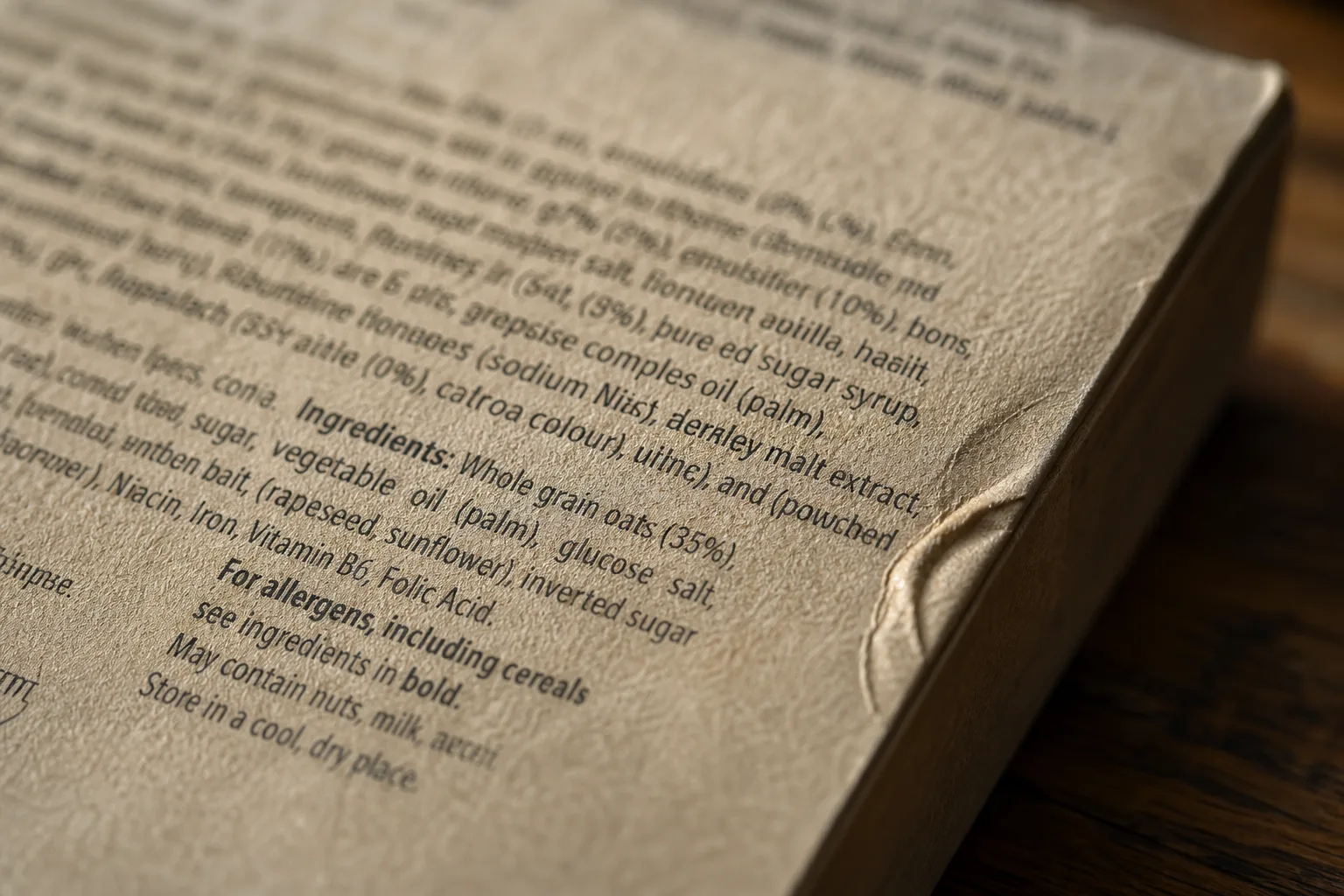
Some words on a label carry a legal definition and can be enforced. Others are marketing with no fixed meaning, and the two sit inches apart on the same box.
The usual assumption about food labeling is that the front of a package is loosely regulated advertising and the back is the honest part, which is close to right but blurs the distinction that actually matters. A fair number of words on the front carry precise legal definitions and can be challenged if used wrongly. Others sitting immediately beside them mean nothing at all in law and can be applied to almost anything. Nothing in the typography distinguishes the two, and a shopper reading the front of a box is reading a mix of enforceable statements and pleasant noise.
The Rough Division
On the enforceable side sit the nutrient content claims and a handful of production terms. Low fat, reduced sodium, good source of fiber, light, lean and free all have numeric thresholds attached, expressed per serving, and a product cannot carry them without meeting the number. Organic is defined and certified through a federal program with inspection behind it. The numeric thresholds sitting under the nutrient claims come from the food labeling rules the Food and Drug Administration writes and enforces, which is the reason a package cannot describe itself as low sodium without meeting a figure somebody could test for in a laboratory.
On the unenforceable side sit most of the words that make a package feel virtuous. Artisan, craft, farm fresh, wholesome, premium, handcrafted, all-natural and simple carry no fixed definitions and impose no requirements. Natural occupies an uncomfortable middle: it is not formally defined in most contexts, though longstanding policy discourages its use where artificial flavors, added color or synthetic substances are present, which is a weaker constraint than most shoppers imagine when they read it.
Why Some Are Enforceable and Some Are Not
The difference is largely about whether a claim can be measured. Sodium per serving is a number that a laboratory can verify, so a threshold can be written and policed. Wholesome describes an impression, and there is no test that distinguishes a wholesome cracker from an unwholesome one, which means a rule could not be enforced even if somebody wrote it. Regulators have generally taken the position that unmeasurable puffery is better addressed by disclosure of the actual composition than by attempting to define words that resist definition.
That is the reason the nutrition panel and the ingredient list exist in the form they do. They are the enforceable counterweight to an unregulated front panel, and they are why the useful reading strategy is to treat the front as an index rather than as information. A claim on the front tells you what the manufacturer wants you to think about, and the back tells you whether it is true, and the two are printed on the same package precisely so that the comparison is available.
The Three That Mislead Most Reliably
Made with real fruit is the first, and it is technically accurate in nearly every instance in which it appears. It says nothing about quantity, so a product containing a small percentage of juice concentrate qualifies exactly as fully as one built around fruit. The ingredient list settles it in seconds, because ingredients appear in descending order by weight, and a fruit that appears after the third sweetener is present in a quantity the front of the package was carefully not mentioning.
No added sugar is the second, and it means what it says while implying something broader. A product can contain a great deal of naturally occurring sugar, or sugar arriving through fruit juice concentrate, and still carry the claim honestly. The third is multigrain, which promises more than one grain and says nothing about whether any of them are whole. Whole grain is the defined term worth looking for, and the ingredient list will name it explicitly as the first ingredient in a product where it genuinely dominates.
What to Read Instead
Three things, in about fifteen seconds. The serving size first, because every number on the panel is scaled to it and packages routinely define a serving smaller than anybody eats. Then the first three ingredients, which is where most of the product's weight is and where any front-panel claim can be checked against reality. Then the one nutrient that matters for the reason you are buying this particular item, which is sodium on soup, added sugar on cereal and yogurt, and fiber on bread.
Where the Front of the Package Is Genuinely Useful
It would be a mistake to end on the idea that the front panel is worthless, because several of the things printed there are both defined and the fastest way to find what you want. Certified organic, the whole grain stamp, gluten free with its specific parts-per-million threshold, and the nutrient content claims with numeric definitions behind them are all reliable shortcuts. So is the country of origin on fresh produce, seafood and meat, which is required rather than voluntary.
The skill worth developing is not skepticism about packaging, which mostly produces exhaustion, but the ability to sort a front panel into two piles in about a second. The words with numbers behind them are doing work. The words describing a mood are decoration, and they are neither dishonest nor useful. Once a shopper can tell which is which, the front of the package becomes what it was always best at being, which is a fast way to find the right shelf, and the back of the package goes back to being where the answer is.