Four Credentials on the Same Wall, and What Each One Costs the Clinic to Keep
title:Four Credentials on the Same Wall, and What Each One Costs the Clinic to Keepauthor:Marguerite Vasquezpublished:2026-02-07section:Healthwords:1,249read:5 min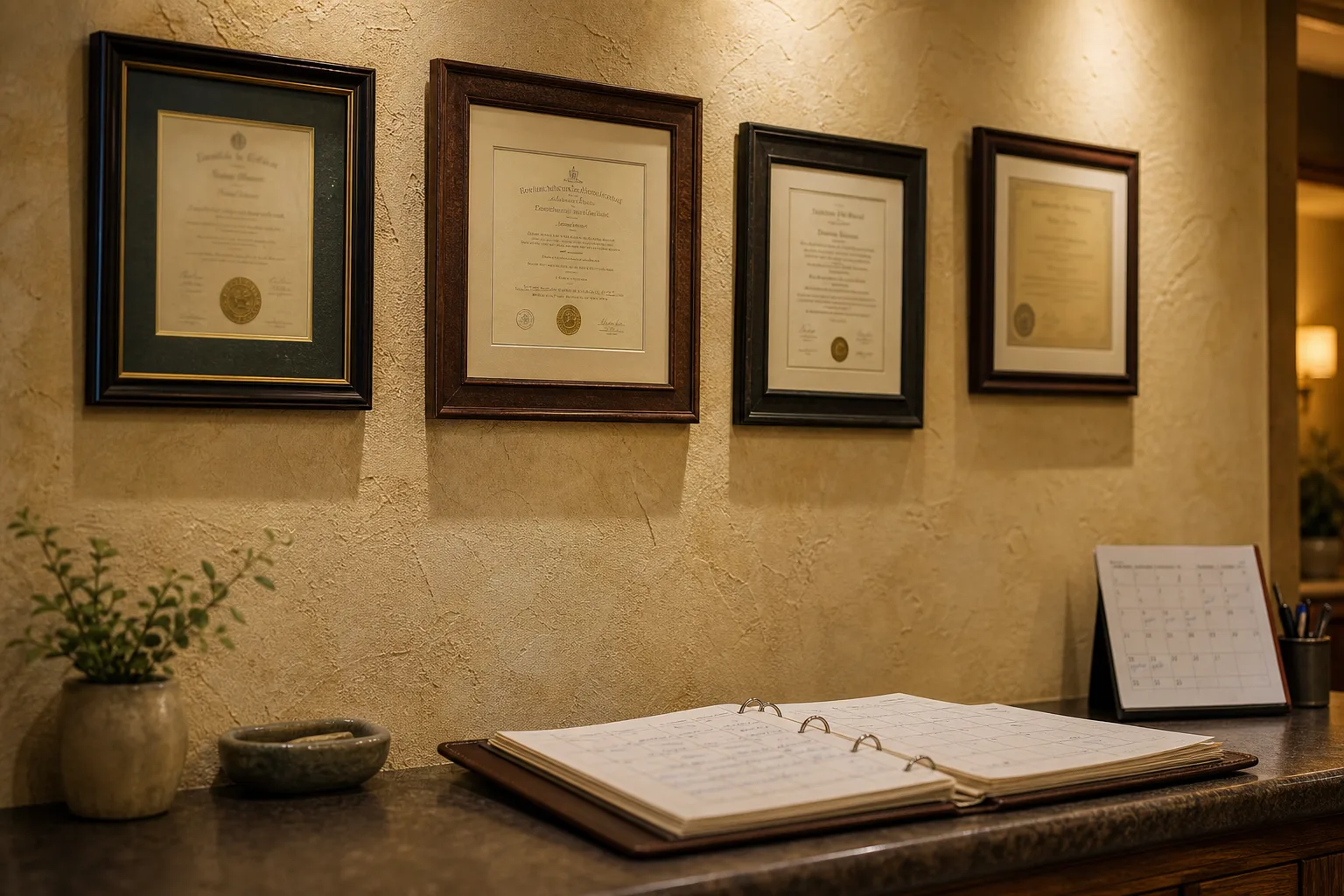
A state license, a national certification, board certification and facility accreditation are four different purchases with four different guarantees. Here is what each one buys.
The framed documents behind the front desk are not four versions of the same thing. They are four separate purchases, made from four separate issuers, renewed on four separate calendars, and they guarantee four different and fairly narrow things. Most patients read them as one blur of legitimacy. Most practices experience them as a recurring line item and a standing appointment with a spreadsheet. Both readings are incomplete in ways that cost money, so it is worth pulling them apart.
The useful question is not which credential is best. It is which one answers the question you actually have, and what the holder had to spend to keep it current. The spending tells you something. A credential that costs almost nothing to maintain is telling you almost nothing about the current state of the person holding it.
The four things, and who issues each
A state license is permission to practice. It is issued by a state board, it is mandatory, and practicing without it is the one failure with legal teeth. A national certification is usually issued by a private body and tests a defined body of knowledge at a point in time. Board certification, in the clinical specialties that use it, sits on top of the license and signals training in a specialty. Facility accreditation applies to the building and the operation rather than to any individual, and it is often what a payer or a referral source is actually looking for.
| Credential | Issued by | Mandatory? | What it actually guarantees | Cost driver |
|---|---|---|---|---|
| State license | State board | Yes | Minimum education and exam met; no disqualifying disciplinary record at renewal | Number of states held, continuing education hours required |
| National certification | Private certifying body | Usually no | Passed a standardized exam covering a defined scope | Exam and recertification fees, study time |
| Board certification | Specialty board | No | Completed specialty training and met that board's ongoing requirements | Years of training already spent, then maintenance requirements |
| Facility accreditation | Accrediting organization | Sometimes, by payer or state | Written policies, equipment and records met a published standard at survey | Survey cycle, staff time preparing, remediation of findings |
Note what is missing from every row in that fourth column. None of them guarantees that a particular visit will go well, that the person you see is the person who holds the credential, or that the price you are quoted is reasonable. Credentials are floor-setters. The Bureau of Labor Statistics tracks which occupations require a license or a certification to work in them, and the pattern across that data is that licensing is a gate, not a ranking.
What the renewal cycle looks like from inside the practice
Here is the part nobody frames and hangs on the wall. Maintaining the set is a job, and in a small practice it is somebody's Tuesday.
The license renewal fee itself is generally the smallest number in the stack. The continuing education attached to it is the larger one, and the reason is arithmetic rather than tuition. A course registration is one figure. A working day out of the chair is a different figure, and for a clinician who bills by the appointment it is usually several times the course fee. That is the assumption to hold onto: for most practitioners, the real cost of a credential is measured in unbilled hours, not in fees paid.
Then the smaller recurring items. Basic life support cards expire. Registrations tied to controlled substances expire. Malpractice coverage renews annually and asks, every year, whether anything about your license status has changed. Payer credentialing has to be revalidated on the payer's schedule, not yours, and a lapse there does not stop you practicing. It stops you getting paid, which for a small clinic is functionally worse because the work continues while the reimbursement does not.
The week-to-week reality is a calendar with a dozen dates on it belonging to a dozen different organizations, none of which coordinate with the others. Practices that handle this well do one specific thing: they put every expiration in one place, with a lead time attached, and they assign it to a named person rather than to the general idea that someone will notice. That single administrative habit is worth more than any individual credential in the stack, because the expensive failures in this area are almost never failures of competence. They are failures of a date going past.
What drives the total, and why two similar clinics land far apart
Two practices offering the same service in the same city can carry very different credentialing costs. The drivers are predictable.
- Number of states. Every additional state license is another fee, another continuing education rulebook, and another renewal date. Telehealth has pushed a lot of practices into holding several, and the cost scales close to linearly.
- Number of payers. Each contract has its own credentialing packet and its own revalidation clock. Ten payers is not ten times the paperwork of one, but it is not far off.
- Headcount. Multiply everything above by the number of licensed staff. This is where a small clinic discovers it needs a person, or a service, rather than a spreadsheet.
- Supervision requirements. Where a credential requires supervised hours, someone senior has to sit those hours. That time is billable elsewhere, which makes supervision one of the quietest large costs in the whole picture.
- Accreditation cycle. A survey year costs materially more than a non-survey year, mostly in preparation time and in fixing whatever the last survey flagged.
Practices that price their services with these numbers visible tend to quote more consistently, because the overhead is already in the rate rather than being rediscovered every renewal season.
What to check when the wall does not answer your question
If you are choosing a practitioner, the frames are the least informative source available to you. Better sources exist and cost nothing.
Every state board publishes a license lookup. It will tell you whether the license is active, when it expires, and whether there is public disciplinary action attached. That is a more current fact than a certificate printed years ago. Certifying bodies typically run their own verification tools, which matter because a certification can lapse while the framed copy stays on the wall indefinitely.
Ask two direct questions. First, who exactly is performing the procedure or service, by name and credential, because in a multi-provider clinic the answer is not always the person whose name is on the door. Second, what scope of practice that person holds, because licensing rules differ by state on who may do what and under whose supervision. Both questions are routine, and a well-run front desk answers them without hesitation.
Reading a quote with the credential stack in mind
When a quote from a licensed practice comes in higher than a quote from an unlicensed or minimally credentialed alternative, the gap is often the stack described above, plus insurance, plus the recordkeeping that accreditation requires. That does not automatically make the higher quote correct. It does make the difference explicable, and explicable differences are the ones you can negotiate or accept on purpose.
What the credentials give you is a documented floor and a place to go if the work goes wrong. A board that can suspend a license is leverage that a review site cannot match. That is the actual product being maintained on the wall: not a promise about your specific appointment, but an accountable party with something to lose, whose standing you can verify yourself in about two minutes.