Five Enrollment Dates Worth Checking Twice, and the Two That Do Not Move
title:Five Enrollment Dates Worth Checking Twice, and the Two That Do Not Moveauthor:Marguerite Vasquezpublished:2026-05-11section:Educationwords:959read:4 min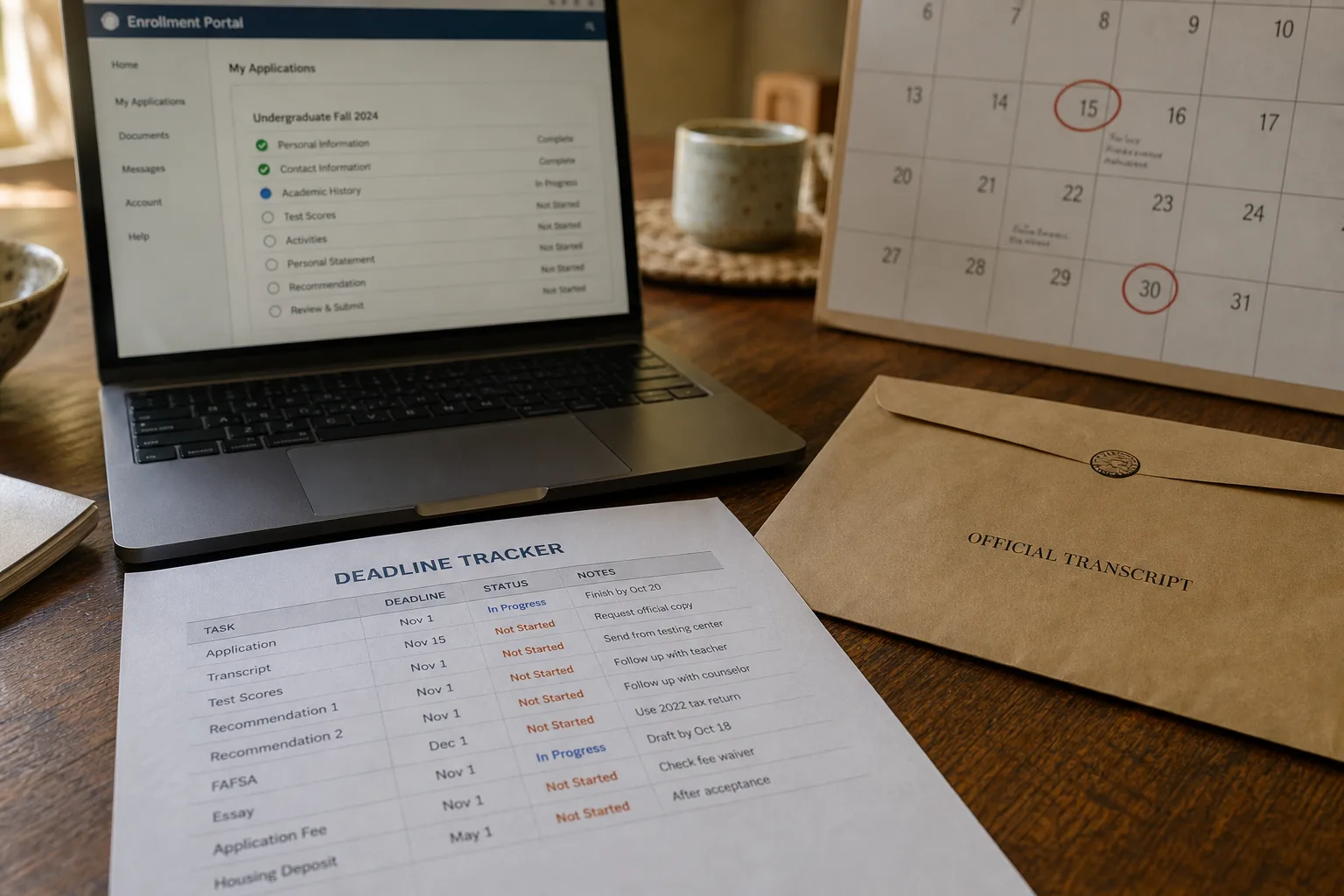
Enrollment paperwork has moved into portals and the calendar shifted with it. Here is how to sort the dates that hold a place from the ones that only set your position in line.
Most families miss an enrollment deadline for a reason that has nothing to do with forgetting. They met the date the school published and then discovered a second date, held by a different office, that governed the money. The published date was real. It just was not the one that decided anything.
The paperwork side of enrollment has changed noticeably in the past few cycles. Federal aid filing opened later than families were used to, and processing ran behind it, which pushed state and institutional award timelines into a compressed window. At the same time, most of the underlying documents moved into portals: transcript requests, immunization records, residency verification, placement testing. That is mostly an improvement. It also means the proof that you filed on time now lives in an account, not in an envelope, and the person who set up the account is often not the person who needs it in March.
1. Whether the date is a wall or a place in line
Two words do most of the damage. A deadline closes something. A priority date ranks you against everyone who filed before you, for money that runs out. Miss a deadline and the application is not considered. Miss a priority date and the application is considered against a smaller pool.
State grant programs and campus aid budgets are the usual place this bites, and it got sharper when the federal filing window shifted. When aid processing runs late, schools tend to hold their own dates and let the queue sort itself out. So the practical instruction is unglamorous: file the federal form the week it opens, not the week it is due, and treat every state and campus aid date as if it were the hard one.
2. Which office actually owns each date
Write the owner next to every date. Not the school. The office. A single enrollment can involve five separate parties, each with its own clock and its own idea of what counts as submitted.
| Date | Who owns it | Typical lead time to satisfy |
|---|---|---|
| Application close | Admissions | Days, once documents are in hand |
| Federal aid filing | Federal processor, then the school | Weeks, if tax records need pulling |
| State grant priority | State agency, not the school | Depends entirely on the federal filing |
| Transcripts and test scores | Prior school or a testing vendor | One to several weeks |
| Immunization or health records | Provider's office | One to several weeks |
| Seat deposit or intent to enroll | Registrar or bursar | Same day, but non-refundable after |
| Tuition and drop or refund dates | Bursar | Fixed and rarely negotiable |
The Department of Education oversees federal student aid, and its filing calendar sits upstream of most of the rows below it. That is why one late federal form can quietly move four other dates. The state agency will not call you about it.
3. The documents with a lead time you do not control
The forms you fill out yourself are almost never the problem. The problem is anything that has to be produced by somebody else: a sealed transcript, a score report from a testing vendor, an immunization history from a pediatrician who changed systems, proof of residency in the right name, a signature from a district office that is closed for two weeks in July.
Order those first, before the application is finished. Most portals will accept an incomplete file and hold it open. Very few will hold a seat while a transcript crawls through a third party's queue in the last week.
4. The deadlines that only exist if something happens
These are the ones no calendar catches, because they are conditional. A waitlist offer with a short response window. An appeal deadline that starts running from the date of a denial letter, not the date you read it. A verification request from a financial aid office that pauses your award until it is answered. A drop date that determines whether a class refunds at full, partial, or nothing.
Verification requests in particular became more common as filing moved online, and they arrive as portal notifications rather than mail. Turn on email alerts for every account, and check the portal message center weekly during the active season even when nothing appears to be pending. A request that sits unread for three weeks looks identical, from the school's side, to a family that did not respond.
5. Proof that you filed on time
Every portal generates something: a confirmation number, a submission timestamp, a status page that reads Received. Capture it. A screenshot with the date visible, saved into one folder, named for the deadline it satisfies.
This is the single cheapest insurance in the process. When a document goes missing between two systems, the conversation is short if you can produce a timestamp and long if you cannot. Keep the login credentials somewhere a second adult in the household can reach them, and put a working phone number and email on every account, not the one from a job you are about to leave.
The tracker that makes it manageable
One page. Columns for the date, the owner, what it decides, what it depends on, and whether proof is filed. Two calendar entries per row: one at the deadline and one two weeks ahead, which is when a third party still has time to help you. Recheck the whole page once a month during the season, because published dates do get moved, and the schools that move them announce it in the portal.
Families who run enrollment this way tend to notice the same thing. The work is not heavier than it used to be. It is just distributed across more accounts, and once the accounts are written down in one place, the deadlines mostly take care of themselves.