Buying a Piece Worth More Than It Looks? The Questions to Ask Before You Talk Price
title:Buying a Piece Worth More Than It Looks? The Questions to Ask Before You Talk Priceauthor:Lionel Karstenspublished:2026-08-24section:Personal Financewords:1,432read:6 min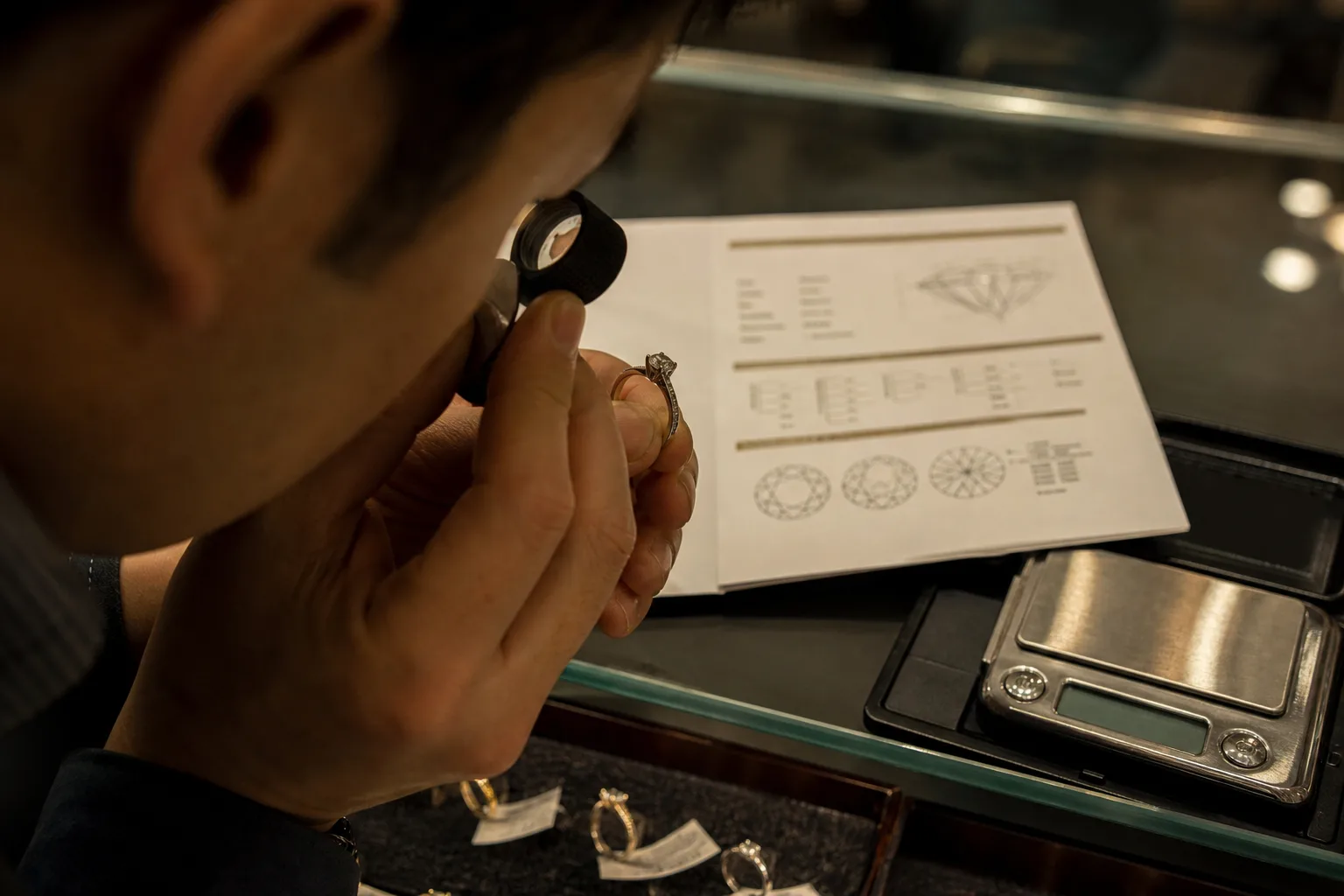
A pocket loupe, four questions in the right order, and three pieces of paper decide whether a jewelry purchase holds its value once you get it home.
The gap between a $900 piece and a $9,000 piece is often invisible across a glass counter under good lighting. That is not a trick anyone is playing on you. It is just what the material is like. Two rings can weigh the same, sit the same on the hand, and read identically to anyone who has not spent years looking. The difference lives in a grading report, a hallmark, a country of origin, and a treatment disclosure, and all four of those are pieces of paper or tiny stamps rather than anything you can see from three feet away.
So the buying job is a documentation job. That is good news for a household, because paperwork is something you can check calmly, and you do not need a trained eye to do it. What follows is how the check actually runs, including the parts that get skipped when nobody is watching.
What to carry, and what it is actually for
Four small things fit in a pocket and change the conversation immediately.
- A 10x loupe. Ten power is the trade standard because clarity grading is defined at that magnification. You are not going to grade anything. You are going to look for the laser inscription on a diamond's girdle, read the hallmark inside a band, and see whether the prongs are cast rough or finished by hand.
- A jeweler's screwdriver or a strong reading light on your phone. Angled light inside a setting shows you solder joints, filled porosity, and whether a stone sits on a proper seat or is floating on glue-like epoxy.
- A small digital scale that reads to 0.01 grams. For gold chains and bangles sold by weight, this is the only honest arbiter. Weigh it in front of the salesperson. Nobody reputable minds.
- A rare-earth magnet. Crude, but it takes two seconds and catches steel cores in things claiming to be solid gold.
Your phone is the fifth tool. Photograph the hallmark, the inscription, and the tag with the stock number, all in focus, before you agree to anything. If the store is reluctant to let you photograph the merchandise you are considering buying, you have learned something useful for free.
The four questions, in this order
Order matters, because each answer changes what the next one is worth.
First: what is the report, and who wrote it? Not "is it certified." Ask which laboratory issued the report, ask for the report number, and ask to see the physical document rather than a photocopy. Independent labs are not all equally strict, and a report written by the seller's own in-house appraiser is a sales document, not an independent one. That is not fraud. It is just a different thing, and it should be priced differently.
Second: what has been done to the stone? Heat, fracture filling, irradiation, diffusion, clarity enhancement, dyeing. Most colored stones on the market have been treated in some way, and treatment is not a defect as long as it is disclosed and priced accordingly. The Federal Trade Commission oversees how jewelry is described and advertised to consumers, including disclosure of treatments and the use of terms like "natural" and "cultured." Ask the question plainly and listen for a plain answer.
Third: what happens to the price if I pay by card? A cash discount of a few percent is normal in the trade. A cash discount of fifteen percent means the card processor's chargeback protection is worth something to you that the seller would rather you not have. On a significant purchase away from home, that protection is one of the few practical remedies you have.
Fourth: what is the return window, in writing, and does it survive me leaving the island? A verbal "of course, no problem" is worth nothing at a distance of two thousand miles. You want a dated policy on the receipt with a number of days and a statement of what condition the piece must be in.
The three documents that do the work
A grading report, an appraisal, and a receipt are three different instruments, and they are routinely confused, including by people selling jewelry.
| Document | What it establishes | What it does not do |
|---|---|---|
| Laboratory grading report | Identity, weight, measurements, grades, treatments, inscription number | Assign a dollar value or vouch for the setting |
| Insurance appraisal | A replacement cost figure your insurer can schedule against | Predict resale value, or prove authenticity on its own |
| Itemized receipt | Who sold it, when, for how much, described how | Anything at all, if it just says "ring" |
The receipt is the one people accept carelessly and regret. It should carry metal and fineness, total weight, stone type and carat weight, any report number, the treatment disclosure, and the price. "14K gold ring with stones" is not a description. If a claim ever gets filed, the adjuster reads that line and pays against it.
An appraisal written the same afternoon by the seller is also common, and it tends to run high. That feels generous and costs you money, because a scheduled item is insured at the appraised figure and you pay premium on it every year. An appraisal that is thirty percent above what the piece would actually cost to replace is a bill you keep paying.
Buying away from home, and getting it back safely
Duty-free ports concentrate a lot of inventory into a few streets, and that concentration is genuinely an advantage: comparison shopping that would take a week at home takes an afternoon on foot. Travelers comparing st thomas jewelry stores are usually deciding between a handful of established counters within a short walk of each other, which means you can carry the same four questions into every one of them and watch how the answers differ.
Practical points for the trip home, from the household side rather than the importer side:
- Know your personal exemption before you shop, not at the airport. Returning residents get a duty-free allowance, and the figure for the U.S. Virgin Islands is more generous than for most destinations. Confirm the current amount with U.S. Customs and Border Protection, and keep the receipt accessible rather than packed.
- Declare it. The duty owed above the exemption on a moderately priced item is small. The consequence of not declaring is not small.
- Carry it on. Checked-baggage coverage for jewelry is effectively nil under airline liability rules, and most travel policies exclude it too.
- Call your insurer within the week. Homeowners policies cap jewelry losses at a low sublimit, often a few thousand dollars for theft regardless of your overall coverage. Scheduling the item as a rider removes the cap and usually the deductible. It is a phone call and a copy of the appraisal.
Photograph the piece on a plain background alongside a ruler, save that image with the scans of all three documents in the same folder, and email it to yourself so it exists somewhere other than your phone. Ten minutes at the kitchen table.
When to walk out and come back
Nothing about this purchase needs to be finished today. The pressure to close is a sales technique, not a market condition, and every seller who is confident in what they have will hold a piece for twenty-four hours against a small deposit with a written note of the terms.
Use that time to look up the report number on the issuing laboratory's own website, where reports are searchable by number and you can confirm the grades match the printed page. Use it to price comparable stones online at the same weight, color, clarity, and cut grade, so you know whether the number in front of you sits inside the range or above it. Use it to call your insurance agent and ask what a rider on that value would cost per year, because that is a real recurring number attached to the purchase.
Come back the next morning having done those three things and you are negotiating from a different position entirely. Most of the time you will find the piece is fairly priced and you will buy it with your shoulders down. Occasionally you will find a gap between the tag and the paperwork, and you will have found it before the money moved rather than four years later in an appraiser's office at home.
The loupe, the scale, the four questions and the folder are the whole method. They cost almost nothing, they take an afternoon to use properly, and they turn a purchase that depends on trusting a stranger into one that depends on documents you can read yourself.