A License Says Who May Do the Work. It Does Not Say Who Did It
title:A License Says Who May Do the Work. It Does Not Say Who Did Itauthor:Lionel Karstenspublished:2025-11-26section:Healthwords:1,112read:5 min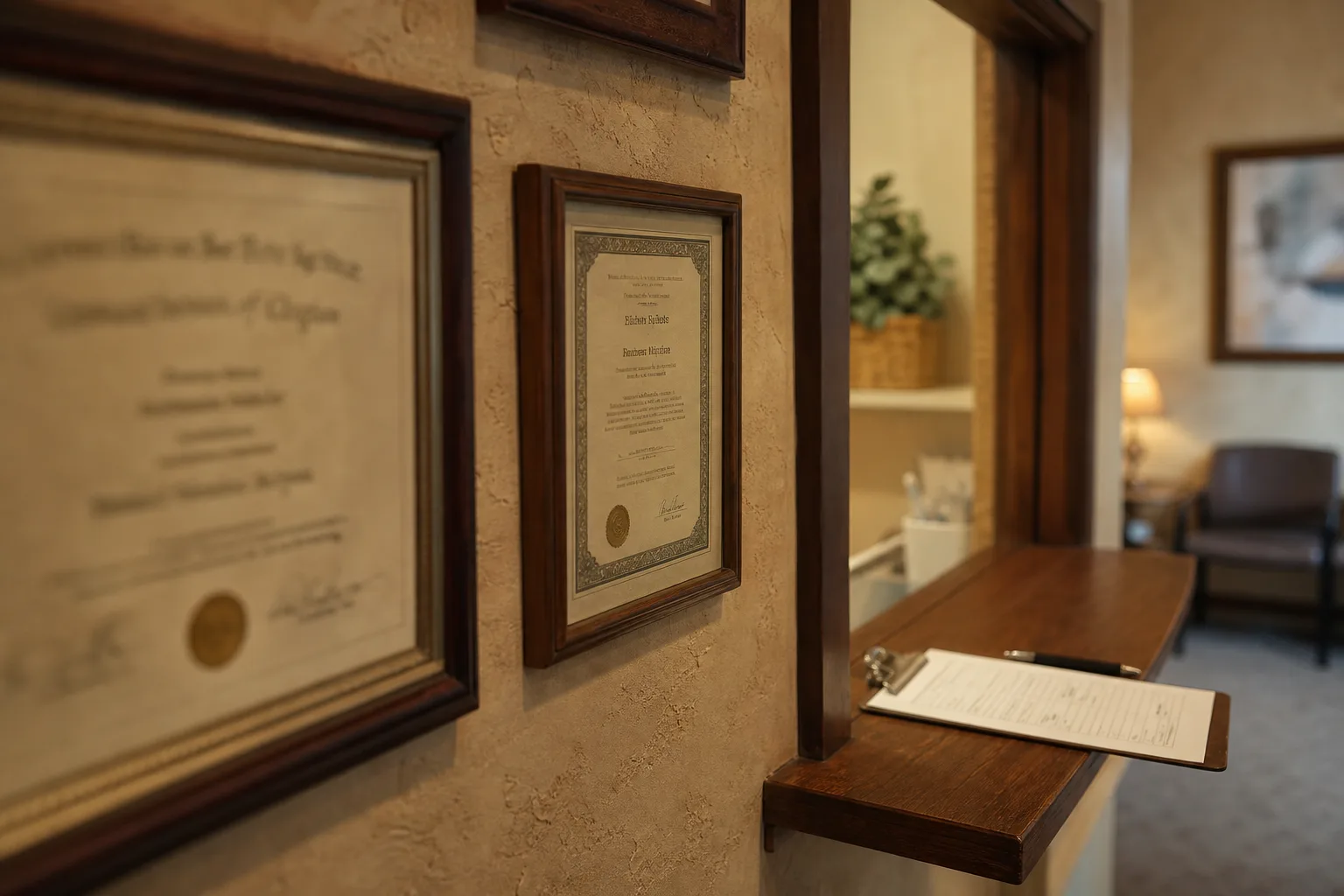
A first visit to a new clinic, reconstructed step by step: which credential was real, which was decorative, and the twenty minutes of checking that sorts them.
The case below is a composite, assembled from the way these first visits usually run rather than from one person's file. The details are ordinary on purpose. Nothing dramatic happened. That is the point: the gap between what a credential guarantees and what a patient assumes it guarantees almost never announces itself, and a first-timer has no baseline to notice it.
A woman in her late thirties books an initial consultation at a clinic offering cosmetic injectables. She found it through a search, checked that the reviews were good, and saw four framed certificates in the waiting room. She had never been to a clinic like this before. She had no idea which of those four documents meant a state agency had checked something, and which meant a company had run a two-day course and printed a name in script.
What actually happened in the room
I spent years on jobs where the licensed person signed the permit and somebody else swung the hammer. The pattern travels. Here is the visit, step by step, the way it went rather than the way it reads on the website.
- The front desk took a photo ID, a card, and a two-page intake form. The medical history section was the shortest part of the form.
- The consultation ran about twelve minutes with the injector, who was a registered nurse. Good hands, plainly experienced, explained the plan clearly.
- The required prescriber contact happened by video on a tablet, lasted under three minutes, and consisted of confirming her name, date of birth, and that she had no allergies. That call is the legal hinge of the whole appointment in many states, and it was the fastest thing that happened all day.
- The product was drawn from a vial already reconstituted, sitting in a small refrigerator with three others. No lot number was read aloud, and the patient was not shown the vial.
- Injection took nine minutes. Aftercare was verbal. She got a receipt, not a chart note.
- Nobody wrote down which side got how many units. She asked. The injector said it was in the system.
None of that is necessarily a violation. Some of it may be perfectly compliant in her state. But every single item is a place where the standard version and the rushed version look identical from the chair, and only the record tells you which one you got. She learned that when she wanted a small correction six weeks later and the clinic could not tell her the dosing map from the first visit.
What the license actually verified
She went home and looked up the credentials. Here is what each one turned out to mean.
| What was on the wall | What a public body had verified | What it did not say |
|---|---|---|
| State nursing license | Education, exam, background check, active status, no open discipline | Nothing about cosmetic injection specifically, or hours performed |
| Certificate from an injectables training course | Attendance, and payment | Whether any skill was assessed, or by whom |
| "Medical Director" plaque with a physician's name | That the physician holds a license somewhere | How often that physician is on site, or reviews charts |
| Manufacturer "certified provider" badge | Purchase volume, in most programs | Clinical outcomes |
A license is a floor, and it is a real one. It means somebody checked that a human being met a minimum standard, can be identified, and can be disciplined. That is worth a great deal, and it is exactly why the lookup is the first thing to do rather than the last. What a license does not do is describe the specific procedure in front of you, or the volume of it, or the paperwork discipline of the practice that employs the licensee. The Food and Drug Administration oversees the drugs and devices being used in that room. The state board oversees the person holding the syringe. Neither one is watching the chart note.
The people standing next to the decision
A first-timer thinks the decision is between herself and the injector. It is not. Four other parties are already in the room, and each one has a different incentive.
The supervising or collaborating prescriber. In many states this relationship, not the injector's license, is what makes the treatment legal. It can be a physician who is physically present, or one who takes video calls between other obligations. Both arrangements can satisfy a statute. They do not deliver the same thing when a complication starts at 8 p.m.
The front desk. Unlicensed, usually paid on a different structure, and the person who decides whether your intake form gets read or filed. Where the medical history gets a real look, the rest of the visit tends to be tidy too. It is a reliable tell.
The insurance credentialer. Where a clinic bills insurance, a third party has already pulled the license, the malpractice coverage, and the sanctions history, more thoroughly than most patients ever will. Cash-only practices skip that filter entirely. Not a scandal, just a filter you no longer get for free.
The board investigator. Complaint-driven and reactive by design. That is not a flaw so much as a structure worth understanding: the board is a backstop, and the useful move is to read what it has already published about a practice before you book, not after.
The twenty minutes that sort it out
Illustrative figures, and I am stating the assumption rather than claiming it: say the package was quoted at $1,200, and say a correction visit plus a dermatology consult would run a third of that again. On those assumptions, the checking below costs nothing and protects a four-figure decision.
| Step | Where | Time |
|---|---|---|
| Verify the license by name and number | Your state's licensing board lookup | 5 min |
| Search disciplinary and enforcement actions for the person and the practice | Same board, separate search | 5 min |
| Ask who the supervising prescriber is, and how the exam is conducted | Phone call before booking | 3 min |
| Ask what the chart note will record: product, lot, units, sites | Same call | 2 min |
| Ask for a copy of the note after the visit | At checkout | 2 min |
The last two questions do most of the work. A practice that documents lot numbers and dosing maps is a practice that expects to be reviewed, and that expectation shows up in everything else, including the twelve-minute consultation. When she booked her follow-up somewhere new, she asked those two questions on the phone. The second clinic answered both without hesitating and emailed the note the same afternoon.
She kept the appointment. The credential got her to a defensible shortlist, and the two questions told her which name on that list ran a tight room.