A Ticket, a Clerk and an Insurer. How to Tell Which Problems Need a Lawyer
title:A Ticket, a Clerk and an Insurer. How to Tell Which Problems Need a Lawyerauthor:Beatrix Stapletonpublished:2026-08-29section:Law & Legalwords:1,281read:5 min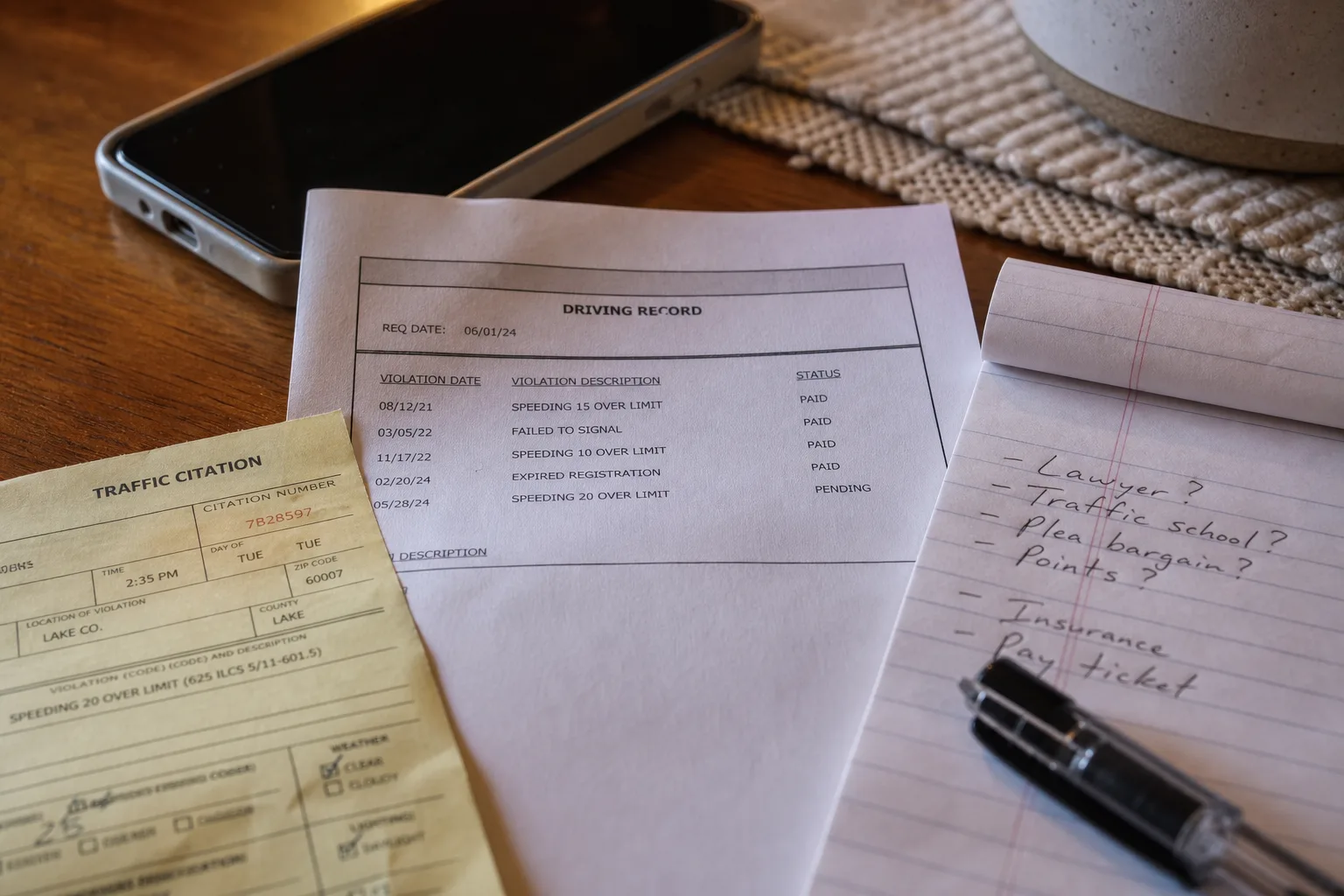
A citation is processed by an organization with a routine. Learning how that routine works is what tells you whether to pay a fee, appear yourself, or write a check.
The envelope says the fine is a fixed dollar figure and the deadline is a date about two weeks out. That number is the least useful thing on the page. What actually determines whether you should hire someone is what happens to the record after you pay: which agency receives it, what that agency does with it automatically, and who at the far end of the chain has discretion to treat you differently from the next person in line.
Most people decide by feel. The fine looks small, so they pay it. The fine looks large, so they call somebody. Feel is a poor instrument here, because the fine is the one cost that is disclosed to you and the downstream costs are the ones that are not.
Read the organization, not the paperwork
A citation is not a dispute between you and the officer who wrote it. It is a document that enters a processing system staffed by people you will probably never meet. A clerk dockets it. A prosecutor or a city attorney's office decides, under an internal policy you have not read, whether the charge is worth negotiating. A hearing examiner or a judge with a calendar of dozens of matters that morning applies a set of habits that are consistent within that courtroom and different two counties over. A licensing agency receives the disposition and applies points or a suspension trigger by rule, without judgment. An insurer picks the record up at renewal and reprices you according to a rating plan filed with the state.
Five separate organizations, each with its own remit, each responding to the same piece of paper. The question worth asking is not "is this serious?" It is "which of these five has discretion, and can that discretion be reached?"
Where nobody has discretion, an attorney has nothing to work with. A parking ticket on a private lot, a registration lapse you have already cured, an equipment citation that gets dismissed on proof of repair: these are administrative, and the outcome is the same whether you show up alone or with counsel. Where discretion exists and is exercised through a repeat relationship, representation is buying access to a process, not eloquence.
Four tests that separate the two categories
These are the questions worth running before you spend anything.
- Does the outcome leave a record that another organization reads automatically? A fine is a one-time cost. A moving violation on a driving abstract is a cost that recurs at every renewal for as long as the insurer's lookback window runs. If the answer is yes, the true price of the ticket is a multiple of the printed number, and the multiple is unknown to you.
- Is your license or your livelihood in the chain? The threshold shifts entirely for anyone who drives commercially. The Federal Motor Carrier Safety Administration oversees commercial driver licensing standards, and the rules that apply to a CDL holder do not work like the rules that apply to a private car. A disposition that a regular driver could absorb can be disqualifying for someone whose job requires the endorsement.
- Is there a human with authority to change the outcome, and does that human take meetings? Prosecutors negotiate. Automated systems do not. If the only path is a form and a payment portal, you are not hiring an advocate, you are hiring a courier.
- Is the deadline yours or someone else's? Response windows on citations are short and unforgiving, and missing one can convert a contestable matter into a default judgment plus a separate failure-to-appear problem. If you are close to a date, the first call is about preserving the option, not about the merits.
What a volume practice knows and a search cannot tell you
There is a real difference between a general practitioner who takes a citation as a favor and a firm that appears in the same courtrooms every week. The difference is not skill in the abstract. It is inventory of local knowledge: which prosecutor's office will amend to a non-moving violation and on what terms, which court requires a personal appearance and which will accept a written motion, how a deferral is scored by that jurisdiction's licensing agency, and whether a particular disposition is treated as a conviction for insurance rating purposes or is not reported at all.
None of that is published. It accumulates through repetition, which is why the practical question when you interview a traffic attorney is how often they handle matters in the specific court named on your notice, not how many years they have been admitted. A firm with volume in one jurisdiction is worth more there than a more decorated lawyer who has never stood in that room.
Volume also changes the economics. Where a practice handles a category of case repeatedly, the work is systematized and the fee is usually flat and quoted up front. That flat fee is comparable against a number you can estimate yourself, which is what makes the decision tractable.
Running the arithmetic before you commit
You will not get exact figures for the downstream costs, and you should not pretend to. What you can do is bound them. Call your insurer's service line and ask what a moving violation of this class does to your premium at renewal, and how many years it stays in the rating window. Ask the court clerk what dispositions are available in that court and whether a deferral counts against you. Ask the licensing agency how many points the charge carries and what the suspension threshold is. All three calls are free. Together they turn a vague worry into a range.
| Signal | Points toward handling it yourself | Points toward representation |
|---|---|---|
| Record effect | Non-moving, not reported to the licensing agency | Moving violation, points assessed, insurer reads it |
| License exposure | Well below the suspension threshold | Near threshold, or a commercial endorsement is involved |
| Discretion available | Fixed penalty, no amendment offered | Prosecutor's office negotiates amendments routinely |
| Complexity of proof | Documentary and already in your possession | Calibration records, officer availability, or witness testimony |
| Fee against exposure | Flat fee exceeds three years of estimated premium change | Flat fee is a fraction of the multi-year cost |
| Calendar | Weeks of runway, one appearance | Conflicting obligations, multiple settings, out-of-state matter |
The bottom row is the one people skip. A representation fee that buys you out of two or three appearances in a courthouse an hour away has a value in time that is easy to price and easy to forget.
Building the judgment so the next one takes ten minutes
The skill transfers. Every problem that lands on a household from an institution has the same shape: a document, a deadline, a processing system, a downstream consequence, and somewhere in the chain a person with authority. A denied claim, a code violation notice, a wage dispute, a property assessment. In each case the useful first move is to map who receives the outcome and who can vary it, before deciding whether to spend money on an advocate.
Keep a note of what you learn each time: which office answered, what the clerk said, how long the record persists. That file is the reason the third one of these takes ten minutes and the first took a week. And when a matter clearly falls on the representation side of the line, having already bounded the exposure means you walk into the consultation able to judge the fee against a number rather than against your nerves.
The clerk who answers the courthouse phone will tell you more in four minutes than an evening of reading will. That call costs nothing and is almost always the right place to start.