Four Rooms, Sixty Thousand Dollars, and the Appraiser Who Credited Half of It
title:Four Rooms, Sixty Thousand Dollars, and the Appraiser Who Credited Half of Itauthor:Beatrix Stapletonpublished:2026-10-07section:Propertywords:1,164read:5 min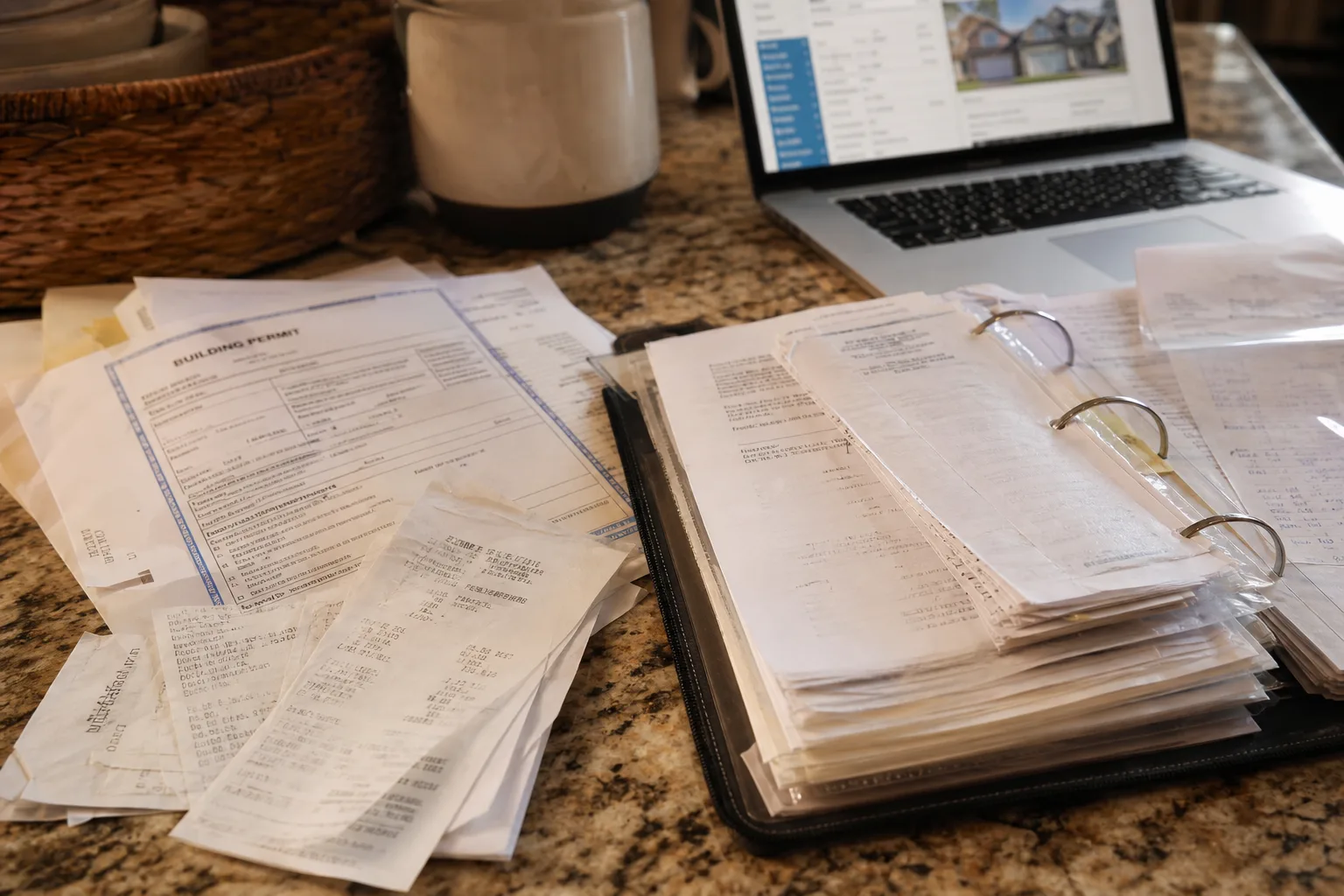
A composite case study of one household's pre-sale renovations, and what the appraiser, inspector, permit clerk and appraisal district each did with the receipts.
The Delgados kept every receipt. Three ring binders, tabbed by room, running from the first demolition invoice in February to the final punch-list payment in September. They spent a little over sixty thousand dollars on a 1978 ranch house they had owned for nineteen years, all of it in the eighteen months before they listed. When the appraisal came back, roughly half that spending showed up as value and the other half did not. The binders had nothing to do with it.
What follows is a composite drawn from the way these transactions ordinarily unfold, with the figures rounded and simplified to make the arithmetic legible. It is not a survey. The point is not the exact dollars. The point is which stranger's judgment attached to each line of the budget, because that is the part a household can actually anticipate.
Four people priced this work, and none of them was the homeowner
By the time the Delgados reached the closing table, their renovation had been evaluated by four separate people who had never spoken to each other.
The appraiser was hired by the buyer's lender. Her job was to support a loan amount, not to reward effort. She worked from closed sales of comparable houses in the surrounding few square miles, adjusted for size, age, lot and condition. Improvements entered her report only to the extent that the market had already paid for them somewhere nearby. The Consumer Financial Protection Bureau is the federal agency responsible for the mortgage disclosure rules that govern how that appraisal reaches the borrower, which is why the Delgados' buyer had a copy of it before closing and shared the condition notes.
The general inspector was hired by the buyer. His report was a list of defects, not a list of upgrades. A new quartz counter did not appear anywhere in his twenty-eight pages. A water heater installed without a drain pan did.
The permit clerk at the city never met the Delgados at all. Her records, pulled by the title company, showed what had been inspected and closed out and what had not.
The county appraisal district appraiser had the quietest role and the longest memory. His valuation drives the property tax bill. He reassessed after the work, which raised the Delgados' carrying cost during the months the house sat on the market.
What each line of the budget actually did
Laid out side by side, the spending sorted itself into three groups: work the appraiser could support with a comparable sale, work that only removed an objection, and work that did neither.
| Item | Spent | Credited in appraisal | Who else cared |
|---|---|---|---|
| Roof replacement, full tear-off | $17,000 | Substantial | Inspector removed a major defect; insurer reduced a surcharge |
| HVAC replacement, 16 SEER | $11,500 | Substantial | Inspector; permit on file and closed |
| Kitchen remodel, cabinets and counters | $21,000 | Partial | Permit clerk flagged unpermitted electrical |
| Primary bath, tile and fixtures | $6,000 | Partial | Inspector noted no exhaust fan termination |
| Sunroom enclosure of covered patio | $4,500 | None | Appraisal district added it to living area; permit clerk had no record |
The roof and the HVAC did the heaviest lifting, and they were the two items the Delgados had resented paying for. Neither shows up in a listing photograph. Both are the sort of thing that an appraiser can bracket with recent comparable sales and that an inspector will otherwise write up in language a buyer reads as leverage.
The kitchen was the expensive lesson. The cabinets and the counters were genuinely nicer than the neighborhood's recent sales supported, so the appraiser credited part of the spend and stopped. Then the title company's permit search showed that a licensed electrician had added two circuits without a permit. That turned a finished room into an open question.
The sunroom that cost money twice
The enclosed patio is worth dwelling on, because it is the most common version of this problem.
The Delgados' contractor framed and glazed a covered patio, ran a mini-split into it, and left the slab and the ceiling insulation as they found them. The county appraisal district counted the result as conditioned living area and the tax assessment rose accordingly. The lender's appraiser declined to count it, because it was not built to the standard of the rest of the house and because the city had no permit or final inspection for it.
So the family paid for the construction, then paid a higher annual property tax bill on it, and received no credit for the square footage in the only valuation that affected the sale price. That is not an unusual outcome. The two appraisals answer different questions and are not obliged to agree.
The fix was procedural rather than structural. A retroactive permit, an electrical inspection, and a corrected ceiling detail brought the room into the record. It took six weeks and a few thousand dollars, and it closed the gap that had been holding up the buyer's underwriting.
The route they modeled and did not take
Midway through the delay, the Delgados priced the alternative. Before any of the renovation work, they had been contacted by investors who buy occupied houses in their condition and resolve the permit history themselves. Those offers are discounted, and the discount is the price of handing the open items to someone else. For a seller carrying two mortgage payments or holding an inherited property three hundred miles away, firms that advertise that we buy houses in new braunfels are buying exactly that problem, and the math sometimes favors them.
Run plainly: a retail sale with repairs, concessions, two months of carrying cost and commission, against a cash offer that closes in three weeks with no inspection contingency and no appraisal. The Delgados' version came out in favor of the retail sale, but only because the roof and the HVAC were already done. Had they listed the house with a twenty-two-year-old roof and an open permit on the patio, the two columns would have been close enough that the speed would have decided it.
The ordering rule that comes out of this
Spend first on the items an inspector will name and an appraiser can bracket. Roof, HVAC, water heater, electrical panel, drainage. Those convert at close to their cost because they remove a specific written objection from a specific person's report.
Pull a permit for anything that touches structure, electrical, plumbing or conditioned square footage, even when the contractor says it is unnecessary. The permit is cheap. The record it creates is what the title company and the lender's appraiser will read.
And before committing to a cosmetic remodel, look at what has actually closed nearby in the past six months. If no comparable sale in the neighborhood supports a twenty-thousand-dollar kitchen, the appraiser will not invent one.
The Delgados sold in November, about four thousand dollars above the lender's original appraised value after the permit was closed and the room was counted. The binders stayed in the garage. The permit record did the work.