Your Renewal Date Is Not the Deadline. Here Is the Paperwork That Tells You What Is
title:Your Renewal Date Is Not the Deadline. Here Is the Paperwork That Tells You What Isauthor:Beatrix Stapletonpublished:2026-10-11section:Commercewords:1,411read:6 min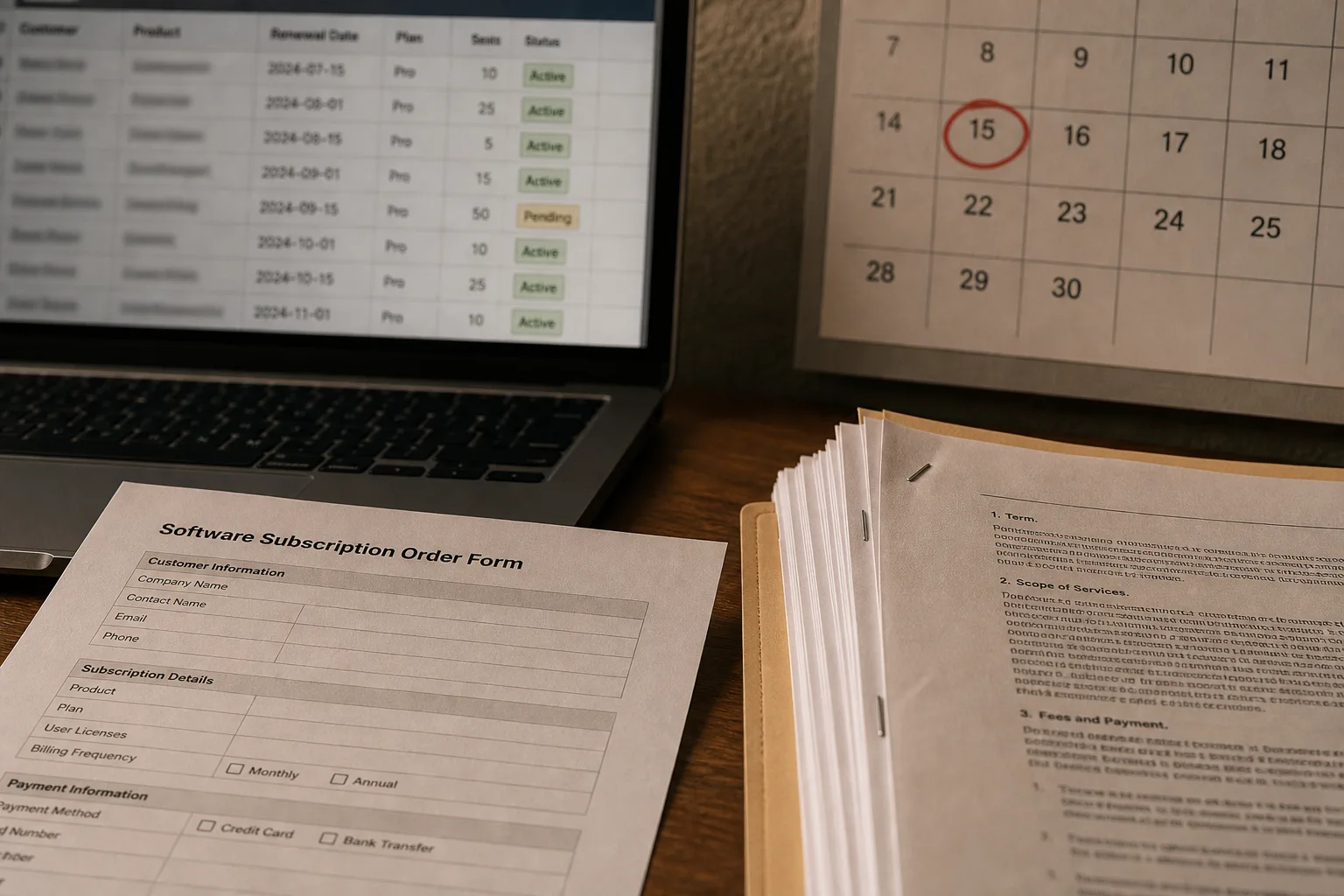
The notice window, not the renewal date, decides whether you have leverage. A practical look at the documents, the register and the people who hold the answers.
A software renewal almost never arrives as a decision. It arrives as a charge on a card statement, or a line in an accounts payable export that looks exactly like the one from last year except it is eleven percent larger. By the time anyone looks at it, the window to do anything about it closed weeks earlier. That window is written down. It is usually one sentence, in one document, and most organizations do not know which document.
The fix is unglamorous and almost entirely clerical. A list, a few saved PDFs, a recurring block on someone's calendar, and the names of four or five people who each hold one piece of the answer. Done once, it takes an afternoon. Maintained, it takes under an hour a month.
The sentence that actually governs the money
Most business software agreements renew automatically for a further term unless one side gives written notice by a stated point before the term ends. Thirty days is common. Sixty is common. Ninety appears in enterprise agreements and in anything sold through a reseller with its own paper. The practical consequence is that a contract ending December 31 may have stopped being negotiable on October 2.
Three details inside that sentence do the work, and they are worth copying out verbatim rather than summarizing:
- The length of the notice period, and whether it is counted in days or months. Sixty days and two months are not the same span and the difference has decided arguments.
- The method. Some agreements accept an email to a named address. Some require certified mail to a legal department. Some say notice through the vendor's support portal does not count, which matters because the support portal is where your administrator will instinctively go.
- What renews. A renewal may carry forward the same seat count, or it may carry forward the peak seat count reached during the term. Those produce different invoices.
Alongside it sits the price escalation clause, often a capped annual uplift. If the cap is stated, the renewal invoice is checkable arithmetic rather than a negotiation. If the renewal quote exceeds the cap, you have a clean, unemotional email to send, and those emails are usually resolved by the vendor's own back office without anyone raising their voice.
Automatic renewal terms in commercial agreements sit near a body of consumer protection rules the Federal Trade Commission is responsible for, which has made clear disclosure of recurring charges a mainstream expectation rather than a courtesy. Vendors selling to businesses have largely followed suit. The notice language is there to be found.
Four documents, and which one wins
A single subscription is rarely a single document. The pile typically includes an order form or quote with the seat count and price, a master services agreement or online terms linked from the order form, a data processing addendum, and possibly a statement of work for implementation. The order form is short and the terms are long, which means the short document is the one people read and the long one is where the notice period usually lives.
Somewhere in the terms is an order of precedence clause saying which document controls if two conflict. Find it. It determines whether the thirty days your sales rep promised on the order form survives the ninety days in the standard terms.
| Document | What it usually settles | Who tends to have a copy |
|---|---|---|
| Order form or quote | Seat count, unit price, term start and end, any negotiated discount | Whoever signed; often the department head |
| Master agreement or online terms | Notice period, price uplift cap, liability, termination rights | Linked from the order form; rarely saved locally |
| Data processing addendum | Where data is held, deletion on termination, subprocessors | IT or whoever handled the security review |
| Invoice history | What you actually paid, and when the price moved | Accounts payable |
Saving all four into one folder per vendor, named with the renewal date, is the single highest-return piece of filing in this whole exercise. The linked online terms deserve a PDF print with the date of capture, because vendors update those pages and the version that applied when you signed is the one you want in hand.
Who else is in the room
The people who can answer a renewal question are scattered across the organization, and none of them owns the whole picture. Knowing who holds what turns a week of archaeology into four short messages.
The accounts payable clerk can produce a spend-by-vendor export in minutes and will usually be glad someone asked. That export is the fastest way to discover subscriptions nobody remembers approving, including the ones running on an individual's corporate card rather than through purchasing.
The IT administrator holds the single sign-on console or identity provider, which shows who logged in and when. Licensed seats and active users diverge quietly after any departure or reorganization. A seat count trimmed to reality before the renewal quote is issued is worth more than any discount argued for afterward.
The renewals representative at the vendor is a different person from the account executive who sold it and from the customer success manager who checks in quarterly. Renewals reps work to a quota and a calendar. They are the right contact for a price question and they generally know their own notice terms cold.
The department head who signed may have agreed to things by email that never made it into the file. Side letters, pilot pricing, a promise that year two would hold flat. Ask directly whether anything was agreed outside the order form.
Finally, whoever handles contract review, internal counsel or an outside attorney, is worth one paid hour on the two or three largest agreements rather than on all of them. Scope the question narrowly: notice mechanics, uplift cap, termination for convenience, data return on exit.
The register, and the hour a month that keeps it alive
A renewal register is a spreadsheet. It does not need to be anything else until you are past perhaps sixty agreements, at which point dedicated software asset management tools start to earn their cost. The columns that matter are few:
- Vendor and product
- Term end date
- Notice deadline, calculated and typed out as its own date, not as "60 days"
- Notice method and the exact address it goes to
- Annual cost and last year's cost
- Licensed seats and active seats
- Internal owner, by name
- Link to the document folder
Typing the notice deadline as a real date is the step people skip and the step that prevents most failures. A date can be put in a calendar. A phrase cannot.
The week-to-week reality is a monthly pass of thirty to sixty minutes. Open the register, look at everything with a notice deadline inside the next four months, and move each one along by one step. Most months this means confirming nothing has changed and closing the file. Occasionally it means a short sequence that spreads across a few weeks rather than landing in one panicked afternoon.
| Time before term end | The task that week |
|---|---|
| 120 days | Pull login data; compare licensed seats to active users; ask the owner whether the tool is still doing the job |
| 90 days | Re-read the notice clause and the uplift cap; confirm the deadline date in the register is right |
| 75 days | Request the renewal quote in writing from the renewals rep; ask for the seat reduction at the same time |
| Notice deadline minus 10 days | Decide. Renew, reduce, or send notice. Send any notice by the stated method and keep the proof |
| After renewal | Check the first invoice against the quote; update the register with the new term end |
Two habits make the monthly pass survive staff turnover. Name an owner for every line, because a register owned by "the team" is owned by nobody. And put the notice deadlines into a shared calendar with the vendor name in the title, so that a reminder landing in someone's inbox is self-explanatory without opening the spreadsheet.
None of this requires leverage, legal sophistication or a hard conversation. It requires knowing one date per contract and holding it earlier than the vendor's billing system does. An organization that reaches its notice deadlines with the seat count already trimmed and the quote already in writing is not in a dispute. It is simply in a position to choose, which is the whole point of reading the paper before the calendar reads it for you.