Surprised Your Policy Excludes Flood? What the Exclusions Are Doing There in the First Place
title:Surprised Your Policy Excludes Flood? What the Exclusions Are Doing There in the First Placeauthor:Lionel Karstenspublished:2026-02-04section:Personal Financewords:1,187read:5 min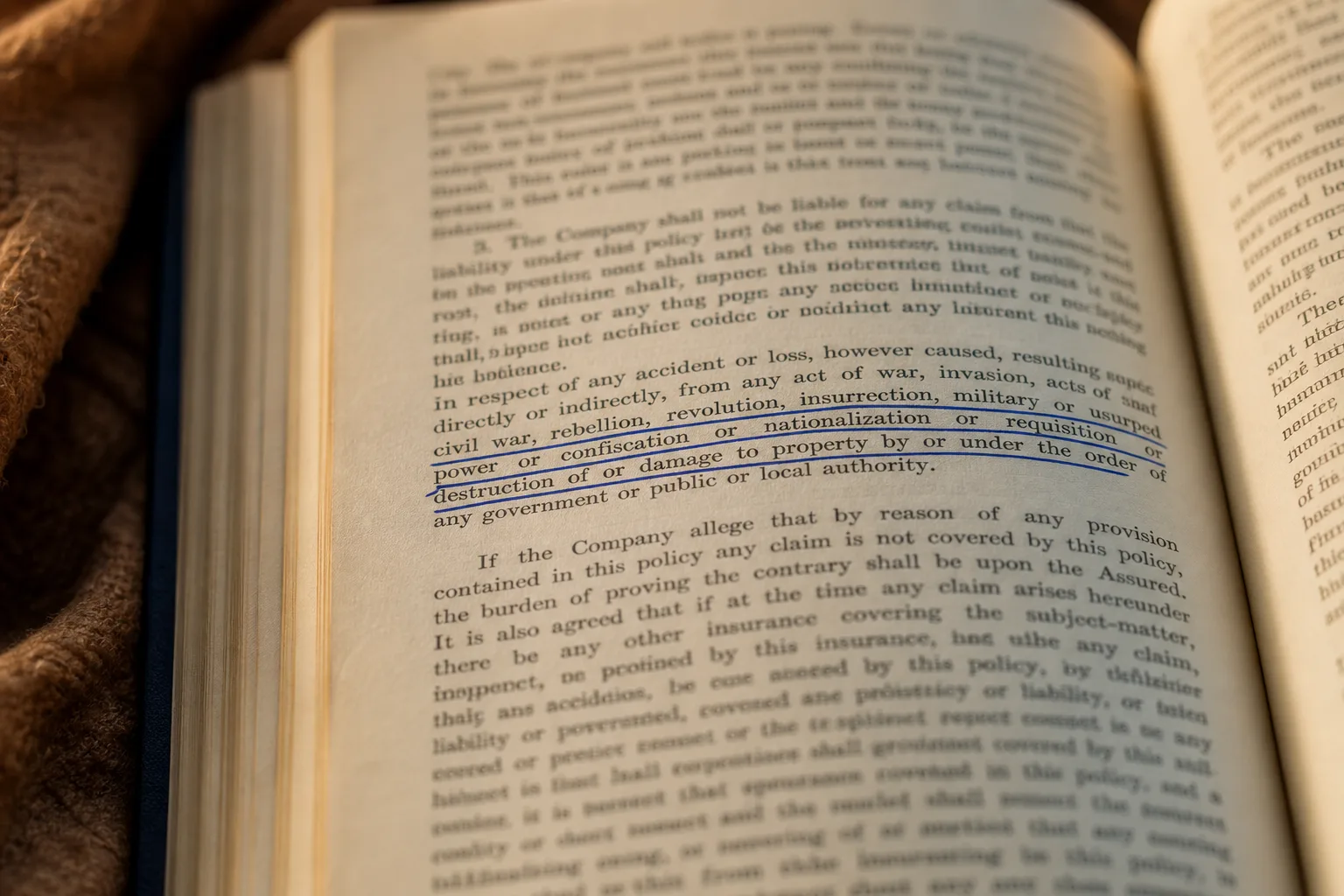
Exclusions are not fine print added to trap people. They are the boundary of what a pooled premium can pay for, and reading them tells you what to buy separately.
The widespread belief about exclusions is that they are the part of the policy written by lawyers to get out of paying, buried where nobody will read them and produced at the worst moment. That reading survives because exclusions are only ever encountered during a denial, which is not a moment conducive to appreciating anything. What they actually are is the boundary of the bargain: the description of which risks this pool of premiums was priced to cover, and by implication a list of the things a household needs to arrange somewhere else. Read that way they are the most useful pages in the document.
The Three Families of Exclusion
The first family covers events that are too correlated to pool. Insurance works because the people paying in do not all suffer losses at once, and a flood, an earthquake or a hurricane storm surge does exactly that, hitting thousands of policyholders in one afternoon. A single carrier writing that risk across a region at ordinary rates would not survive its first event, which is why these perils are handled through specialized markets, federal programs or separate policies rather than folded into a standard form.
The second family covers things that are certain rather than uncertain. Wear and tear, rust, rot, mold from a long-term source, mechanical breakdown from age, and settling all happen to every building eventually, and insuring a certainty simply means paying its cost plus administration. The third family covers what the policyholder controls: intentional damage, neglect, illegal activity, and the failure to protect the property after a loss has already begun. Every exclusion in a standard homeowners policy belongs to one of these three, and knowing which one explains why it is there.
Water, Which Is Where Most Disputes Live
Water is not excluded. Specific kinds of water are, and the distinctions matter enormously in practice. A pipe that bursts and discharges suddenly is covered. Water rising from outside the building, whether from a river, a storm surge, an overwhelmed storm drain or surface runoff across the yard, is the excluded peril called flood. Water backing up through a drain or a sewer is a third category, excluded by default in most forms and available cheaply by endorsement, which is why it is one of the most commonly missing coverages in an otherwise well-built policy.
The dividing line is generally where the water was immediately before it caused damage, not where it originally came from, which is why the same storm can produce a covered claim in one house and an excluded one next door. Rain entering through a roof opened by wind is usually covered, because the wind created the opening. The same rain entering through a roof that was simply worn out is usually not, because the cause was deterioration. That single distinction accounts for a large share of the disagreements that reach an appraisal or a complaint.
The Clause That Surprises People
Earth movement is the exclusion that catches households who never thought of themselves as living in earthquake country. It typically covers not just earthquakes but landslide, mudflow, sinkhole, subsidence and the settling of soil, which means a foundation problem caused by expansive clay or by a slope failing after heavy rain falls outside the policy in most states. The gap is closed by a separate earthquake policy or, in some regions, by a difference in conditions form, and the premium reflects the local geology rather than any national average.
The second surprise is the ordinance or law exclusion, which limits how much a policy pays toward bringing an undamaged part of a building up to current code during a repair. Rebuild half a house after a fire and the electrical or structural requirements that have changed since it was built can apply to the whole thing, and the difference lands on the owner unless an ordinance or law endorsement is in place. This is one of the least understood and most useful endorsements available on an older property.
Reading the Exceptions, Which Is Where Coverage Hides
Exclusions are frequently followed by exceptions, and the exceptions restore coverage in defined situations. A policy may exclude damage from freezing pipes and then except that exclusion where the household maintained heat or shut off and drained the system, which converts a blanket exclusion into a conditional one that a reasonable person can satisfy. Similarly, mold is broadly excluded and yet commonly covered when it results directly from a covered water loss that was reported and remediated promptly, subject to a sub-limit.
This is why reading only the exclusions produces a bleaker picture than the policy actually delivers. The structure is a general grant of coverage, a set of exclusions carved out of it, and a set of exceptions carved back in, and the third layer is where a good deal of practical protection lives. It is also where a household's own conduct starts to matter, since most of the exceptions are conditioned on doing something sensible and being able to show it was done.
Closing the Gaps Deliberately
Once the exclusions are read as a shopping list, the moves are specific rather than vague. Flood coverage is available through the National Flood Insurance Program administered by FEMA and, increasingly, through private carriers, and it is worth pricing even outside a mapped high-risk zone, since a meaningful share of flood claims come from outside those zones. Sewer and drain backup is an inexpensive endorsement. Earthquake is a separate policy. Service line and equipment breakdown endorsements cover the buried and mechanical failures that the wear exclusion otherwise leaves with the owner.
Each of these is a deliberate purchase rather than a default, which is the practical consequence of how the standard form is built. A household that has read its exclusions and bought two endorsements has a policy that reflects its actual exposure. A household that has not read them has a policy that reflects the average exposure of everybody who bought the same form, which is fine until the day it is not.
How to Read Your Own Policy in Twenty Minutes
Start with the declarations page, which gives the form number, the limits, the deductibles and the list of endorsements already attached. Then find the exclusions section in the form itself and read only the headings, which takes about three minutes and tells you the shape of what is missing. Then read in full the three or four that plausibly apply to your building and your region, and note the exceptions attached to each. Finally, check the endorsement list against the gaps you just identified.
Do that once and the document stops being an adversary. The exclusions turn out to describe a coherent product rather than a trap, and the twenty minutes converts a set of unknown gaps into a short list of decisions, most of which cost less annually than people assume. Encountering an exclusion for the first time during a claim is the expensive way to learn what a policy was priced to do, and it is entirely avoidable on an ordinary evening with the form and a pen.