Fifteen Minutes Once a Year: The Renewal Notice Is Worth Reading Line by Line
title:Fifteen Minutes Once a Year: The Renewal Notice Is Worth Reading Line by Lineauthor:Beatrix Stapletonpublished:2026-06-02section:Personal Financewords:1,209read:5 min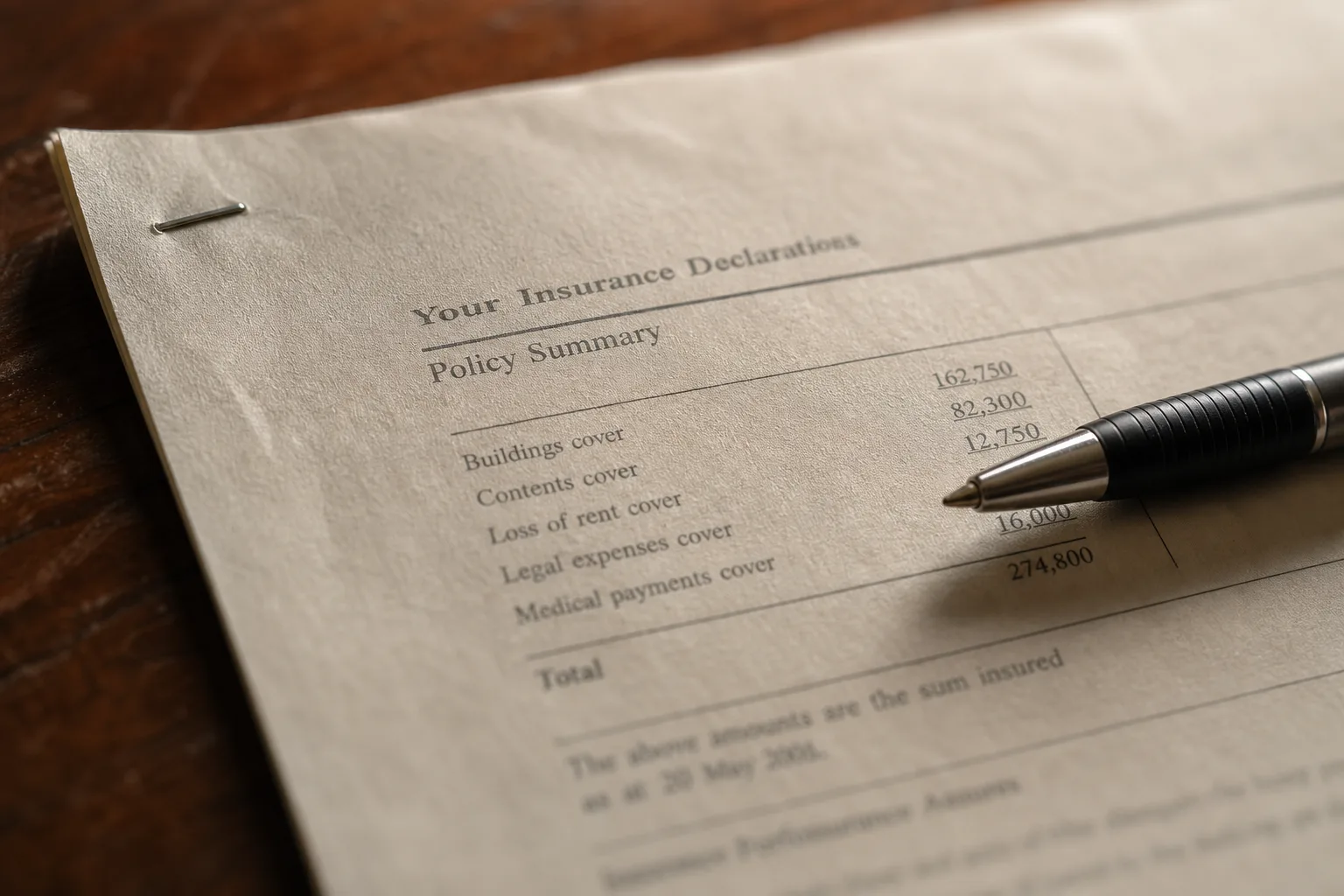
A renewal arrives once a year, states everything the policy will and will not do, and takes a quarter of an hour to check. Most of them are never opened.
Look at the envelope that arrives from an insurer six weeks before a policy renews, which in most households moves from the mailbox to a pile and from the pile to a drawer without being opened. Inside is a declarations page that states, in about a page and a half, every limit, every deductible, every endorsement and every discount that will govern what happens if something goes wrong in the coming twelve months. It is the only document all year that describes the whole arrangement, and it arrives at the one moment when changing it is easy.
The Four Limits, Checked Against the World
Four numbers do most of the work. Dwelling coverage should approximate what it would cost to rebuild the structure at today's local construction prices, which is not the market value and not the purchase price, since land does not burn. Other structures covers detached garages, fences and sheds and is usually a fixed percentage of the dwelling figure. Personal property is another percentage, and loss of use, which pays for somewhere to live during a rebuild, is a third.
Check the first against reality and the rest follow, because they are derived from it. The two questions worth asking are whether construction costs in the area have moved since the number was set, and whether the house has changed. A finished basement, an addition, a new kitchen or a converted garage all raise the rebuild cost, and almost none of them get reported. A limit that was accurate five years ago and has been indexed at a general rate since is very likely short today, and short limits reduce payment on partial losses as well as total ones.
Deductibles, Which Have Quietly Become Several
Most policies used to carry one deductible and now carry two or three. Alongside the standard flat amount sit separate deductibles for wind and hail, for named storms, and in some regions for earthquake or water damage, and the important detail is that these are frequently expressed as a percentage of the dwelling limit rather than as a dollar figure. A percentage deductible on a substantial house is a large number, and it is the one homeowners are most often surprised by.
Read what triggers each one, since the definitions are specific and consequential. A named storm deductible applies only when a storm has been named by the relevant weather authority, which means an unnamed system producing identical damage falls under the ordinary deductible. Roof deductibles and roof valuation schedules appear on more policies every year and change the settlement on the single most claimed component of a house. All of this is stated on the declarations page in a form that takes about two minutes to read.
The Endorsement List, Which Is the Real Content
Below the limits sits a list of form numbers and short titles, and this is where the policy is actually customized. Sewer and drain backup, service line, equipment breakdown, scheduled personal property, ordinance or law, extended replacement cost, water damage limitations and identity theft all appear here, and their absence is as informative as their presence. Reading the list against the house is the highest-value part of the exercise, because it is where a household discovers that something it assumed was covered was never purchased.
The list also carries the restrictions. Endorsements that limit water damage, cap mold remediation, exclude a particular breed of dog, or apply an actual cash value schedule to a roof are all added by form number in exactly the same way as the ones that extend coverage. A form number with a title you cannot interpret is worth a phone call, and the call is short because the agent has the same list in front of them.
What Changed Since Last Year
The most efficient way to read a renewal is against the previous one, since the differences are the news. Insurers do change forms at renewal, and while material reductions in coverage generally require notice, the notice is a document that looks exactly like every other document in the envelope. Sitting the two declarations pages side by side takes a minute and surfaces any changed limit, added deductible, dropped endorsement or altered valuation basis immediately.
Premium movement deserves the same treatment. A premium that rose while the limits stayed flat means rating changed rather than coverage, and it is worth asking why, because the answer is sometimes a claim, sometimes a regional filing, and occasionally a discount that quietly expired. A premium that fell is worth the same question, since the usual reason is that something was removed.
The Discounts Nobody Applies, and the Liability Limit Nobody Reads
Discounts are listed on the declarations page and they are not applied automatically to circumstances the insurer does not know about. Monitored alarms, water leak detection devices, updated roofing, updated electrical or plumbing, a new heating system, retirement, bundling policies, and paperless billing all commonly carry one. Reviewing the list once a year and mentioning anything that changed is a two-minute conversation that occasionally pays for itself several times over.
Personal liability is the coverage everybody has, nobody reads and very few have thought about since the policy was written. It pays when somebody is injured on the property or by a household member elsewhere, and the standard limit has not kept pace with the cost of a serious injury. Raising it is unusually cheap, and an umbrella policy sitting above both the home and auto limits is cheaper per dollar of protection than almost anything else available, which is why the households most exposed to a liability judgment are frequently the ones who have never priced one.
Shopping It, and the Years Not to Bother
A renewal is also the natural moment to test the market, and the honest advice is to do it every few years rather than every year. Quoting is slow, carriers price new business differently from renewals, and a household that switches annually loses the loyalty and claims-free credits that accumulate on a stable policy. What triggers a genuine shop is a premium jump that the limits do not explain, a claim that changed the rating, a material change to the house, or a carrier reducing coverage at renewal.
If you do shop, compare the same coverage rather than the same premium, which means lining up the four limits, every deductible and the endorsement list side by side. A quote that is cheaper because it carries a percentage wind deductible and no sewer backup endorsement is not a cheaper policy, it is a smaller one. Ask the existing carrier to review the account before moving, since the discounts that have quietly lapsed are often reinstated by the same phone call that was going to be a cancellation.
Fifteen minutes, once a year, on a document that arrives without being asked for. The renewal notice is the only point in the cycle where all of this is visible in one place, where changing it costs nothing but a phone call, and where the household still has time to shop if the answer is unsatisfactory. Everything in the drawer is a decision that was made by default, and the drawer is where most homeowners insurance is actually configured.