Hit by a Commercial Truck? What to Bring to the First Meeting, and Why the Clock Moved
title:Hit by a Commercial Truck? What to Bring to the First Meeting, and Why the Clock Movedauthor:Marguerite Vasquezpublished:2026-08-12section:Law & Legalwords:1,437read:6 min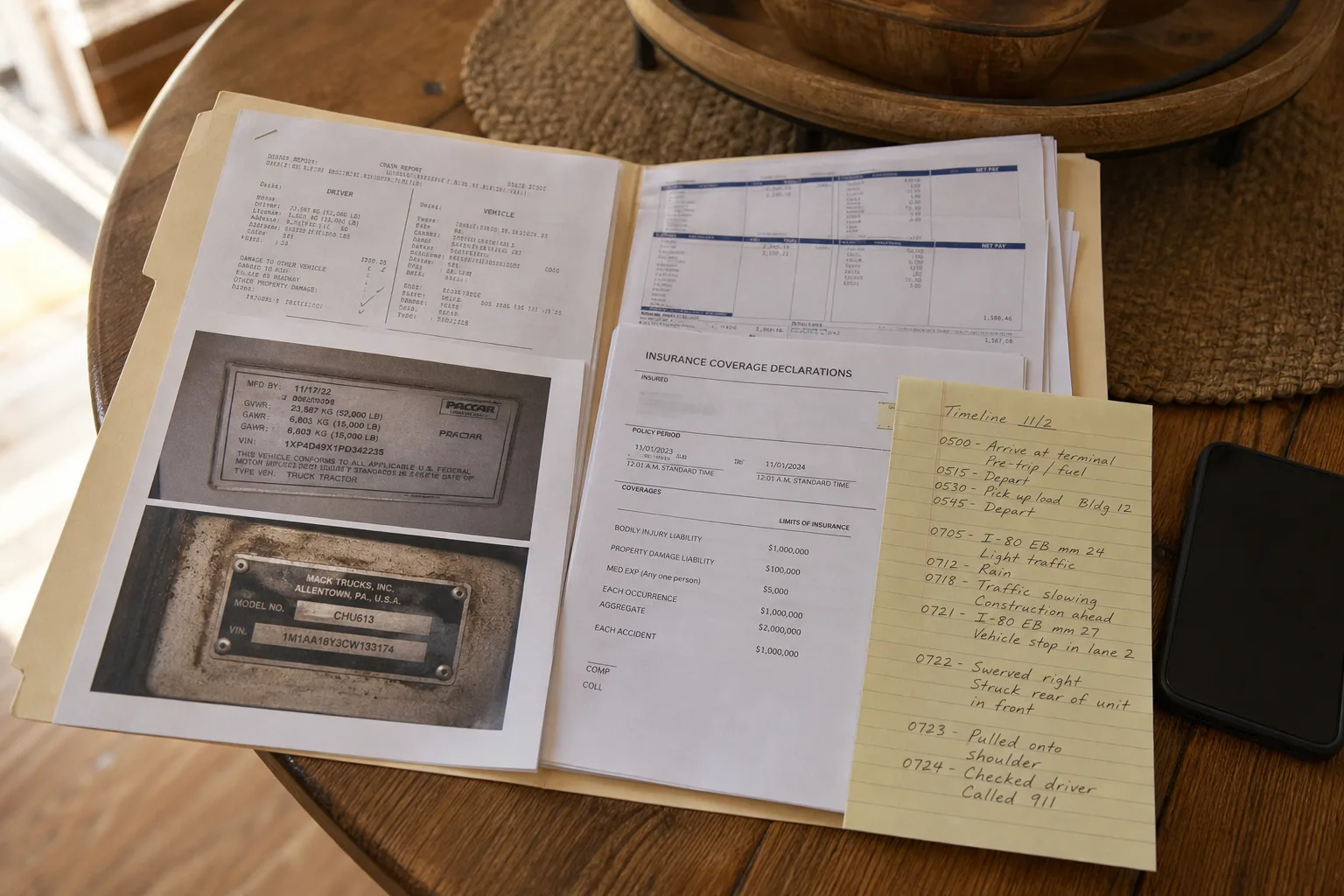
Truck crash evidence now lives on devices that overwrite themselves in weeks. What you carry into a first consultation decides how fast preservation can start.
A first meeting with a lawyer after a wreck with a tractor-trailer runs somewhere between forty minutes and ninety. Most of that is talking. The part that determines what happens next is the ten minutes spent on what you handed over and what you could name. Two people can walk into the same office with the same injuries and the same crash, and one of them leaves with a preservation letter going out that afternoon while the other leaves with a request to come back once they have found their insurance card. The difference is not luck and it is not the lawyer. It is preparation, and the standard for adequate preparation has moved in the last several years because the evidence has moved.
What changed: the evidence now expires on its own
Ten years ago, the core proof in a commercial vehicle case was paper and people. Driver logs kept by hand. A police report. Witness statements. Skid marks and photographs. Paper sits in a file cabinet and does not delete itself. A case built on paper could tolerate a client who took six weeks to make a phone call.
That is not the situation now. Hours-of-service compliance moved to electronic logging devices, which the Federal Motor Carrier Safety Administration oversees as part of its authority over interstate motor carriers. Fleets added telematics, GPS pings at short intervals, engine control modules that capture the last seconds before an impact, forward-facing and driver-facing cameras, and dispatch messaging systems. Every one of those is a recording. Almost every one of them has a retention window, and the window is set by the carrier's own policy or by the vendor's default, not by your convenience.
Some of these windows are measured in months. Some are measured in days. A camera system that only saves clips flagged by a hard-braking event will overwrite unflagged footage on a rolling basis. An engine module can be overwritten by subsequent ignition cycles if the truck goes back into service, which is exactly what a carrier wants to happen to a truck that is otherwise sitting idle and earning nothing.
So the practical meaning of a first meeting has shifted. It used to be an intake. Now it is the starting gun on a preservation effort, and preservation letters have to name things with enough specificity that a carrier cannot claim it did not know what to hold. The lawyer supplies the legal language. You supply the facts that make the list specific.
Barely adequate versus good, item by item
Barely adequate preparation means you show up with the crash report number and your own insurance information, and you can describe what happened. That is enough to open a file. Good preparation means the person across the table can identify the carrier, the tractor, the trailer, and the likely categories of electronic record within the hour.
| Item | Barely adequate | Good, and why it matters |
|---|---|---|
| Identifying the truck | "A red semi" | Photos of the door placard, the USDOT number, the trailer number, and the plate. These let a carrier be identified even when the name on the trailer belongs to a different company than the one employing the driver. |
| The crash report | Report number written on a card | The full report, plus the officer's name and agency. Supplemental reports and any commercial vehicle inspection performed at the scene are often separate documents requested separately. |
| Your own photos | Two shots of your bumper | Wide shots showing lane position and final rest, the underride guard, tire condition, load securement, and any placards. Photos with original timestamps intact, not screenshots. |
| Witnesses | "Someone stopped" | Names and phone numbers, even partial. A first name and a phone number is workable. A description of a car is not. |
| Medical | "I went to the ER" | Every facility and provider seen since the crash, with dates. Gaps in treatment are the single most common argument used to discount an injury claim. |
| Insurance contact | Nothing | The name, company, and claim number of every adjuster who has called you, and whether you gave a recorded statement. |
| Wage loss | "I missed some work" | Recent pay stubs or, if self-employed, last year's Schedule C and invoices from the affected weeks. |
The right-hand column is not a wish list. It is the set of facts that convert a general preservation demand into a specific one, and specificity is what makes a preservation demand hard to ignore later.
The other thing that changed: the carrier moved first
Large carriers and their insurers now run rapid response programs. An adjuster, and in serious cases an investigator or a defense attorney, can be at the scene within hours. They photograph the vehicles before they are moved to a lot. They download the engine module. They interview the driver while the memory is fresh and while the driver is still an employee. They secure the dashcam file.
That is not misconduct. It is competent claims handling, and any well-run fleet does it. But it means the two sides do not start at the same moment. The carrier's record of the crash is complete by the end of the first day. Yours may still be a phone full of photos and an appointment you have not made yet. This asymmetry is the practical reason people are told to consult a truck accident attorney earlier after a commercial vehicle crash than they would after a fender-bender with a neighbor, and it is a resourcing question rather than an urgency slogan.
There is a second consequence worth understanding before you sit down. If an adjuster has already called you and taken a recorded statement, that is a fact the lawyer needs on the first day, not the third week. It is not fatal. It is a thing to be worked with. But it changes the sequence of what happens next, and a statement discovered later is worse than a statement disclosed early.
How to organize what you have, in one evening
Do this once, properly, and the meeting becomes a strategy session instead of a scavenger hunt.
- One folder, physical or digital, with everything in it. No separate texts, no "I'll email you that later." Later has a way of arriving after a retention window closes.
- A one-page timeline. Date and time of the crash, weather, direction of travel, where you were going, and every medical visit since with the date. One page. Facts only, no conclusions about fault.
- Every photo and video, at original resolution. Transfer the files themselves rather than sending compressed copies through a messaging app, which strips the metadata that establishes when the image was made.
- A contact list. Adjusters who called, witnesses, the tow yard holding your vehicle, your employer's HR contact.
- Your own policy declarations page. Underinsured motorist coverage and medical payments coverage on your own policy are frequently overlooked and frequently relevant, particularly where damages exceed what a single liability policy will cover.
- A written list of questions. Fee structure and what expenses are advanced. Who will actually handle the file day to day. What the office needs from you in the next fourteen days. What happens if the case does not resolve.
The vehicle deserves its own line. If your car is in a storage yard accruing daily fees, say so at the meeting, because someone may want it inspected before it is released or sold for salvage. A vehicle that has already gone to auction is a piece of evidence that cannot be recovered, and the storage bill is small next to what the vehicle can establish.
What good preparation actually buys you
It buys speed on the one task that cannot be done late. A preservation letter that names the tractor number, the trailer number, the date, the approximate time, and the specific systems to be held is a different document from one that asks a carrier to preserve "all relevant records." The first is enforceable in a way the second struggles to be.
It also buys you an honest early read. A lawyer working from a complete picture on day one can tell you whether the case is straightforward, whether coverage looks adequate, and where the genuine weak points are. A lawyer working from fragments can only tell you to come back. That second meeting costs you two or three weeks, and in a case where the proof is sitting on a hard drive with a rolling overwrite, weeks are the currency.
Gather it in one evening. Bring it in one folder. The meeting will be worth what you paid for it, and the work that has to start immediately will actually start immediately.