The Cost of a Water Loss Is Set by the Hour, Not by the Gallon
title:The Cost of a Water Loss Is Set by the Hour, Not by the Gallonauthor:Beatrix Stapletonpublished:2025-12-01section:Propertywords:1,190read:5 min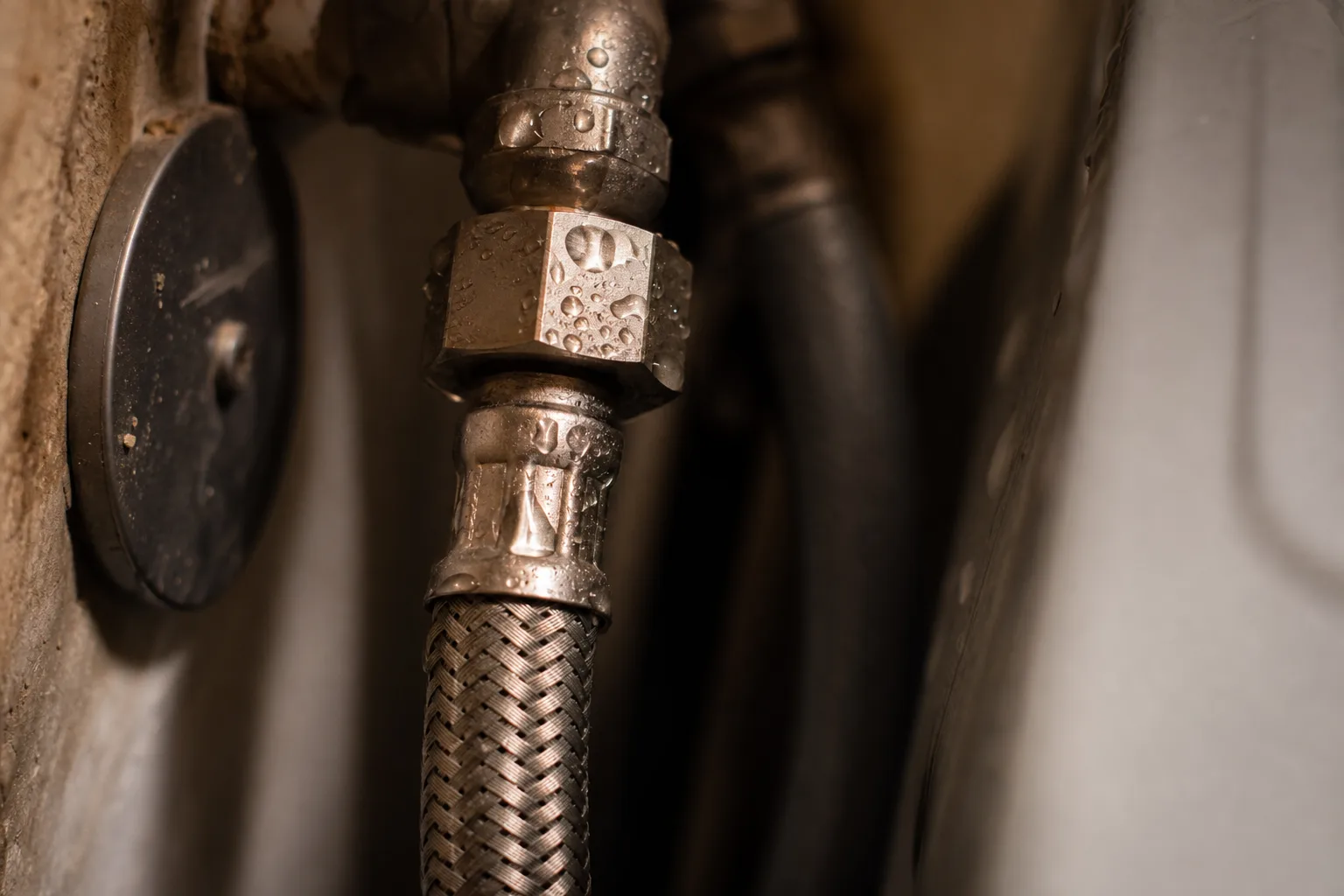
What a water loss costs is governed less by how much water arrived than by how many hours it sat, and the steepest part of that curve is the first day.
The braided steel supply line behind a washing machine is a component almost nobody has looked at, sitting under constant pressure, connected to a fixture that is often the farthest thing in the house from anybody's attention. When one lets go it does not drip. It delivers water at the rate the main will supply it, continuously, until somebody turns a valve, and the difference between a loss that costs a few hundred dollars and one that costs several thousand is usually measured in hours rather than in gallons. That relationship is the single most useful thing to understand about water damage, because it is the only part of it anybody can influence.
The Cost Curve, Roughly Described
For the first few hours, water sits on surfaces and in the top layer of whatever it has reached. Hard flooring can be squeegeed, a carpet can be extracted, and the job is a cleanup with drying equipment for a couple of days. Somewhere in the first day the water moves into the materials themselves, wicking up drywall by capillary action, soaking into subfloor, and travelling under baseboards into wall cavities where nothing can be seen and nothing dries on its own. That transition is where the cost roughly doubles, because the work changes from removing water to removing materials.
Past the second day, the curve turns again, and it does so for biological rather than structural reasons. Wet cellulose in an enclosed cavity at room temperature is a growth medium, and once growth begins the job acquires a containment requirement, additional labor, disposal rules and frequently a specialist assessment. Nothing about the original volume of water changed. What changed is that time converted a drying problem into a remediation problem, and remediation is priced differently at every stage from the first phone call to the final clearance.
The First Hour, in Order
The order is fixed and each step takes minutes. Stop the water at the fixture shutoff if it turns, and at the main if it does not, which is why the location of the main is worth knowing before it is needed rather than at two in the morning. Kill power to affected circuits at the panel if water is anywhere near outlets, cords or a finished basement. Then move what can be moved: rugs off wet floors, furniture legs onto blocks or foil, boxes and paper off the ground, since paper and cardboard wick faster than anything else in the house.
After that comes the part people skip, which is documentation, and it costs about ten minutes. Photograph and video everything before anything is removed or moved, including the failed component itself, which should be kept rather than thrown away. Note the time you discovered it. Then start moving air and lowering humidity with whatever is available while the professionals are called. The point of the household effort is not to finish the job. It is to hold the curve flat during the hours before equipment arrives, which is exactly when the curve is steepest.
What Drives the Number, and What Does Not
Four things account for most of the variation between one bill and another. How long the water sat, which has already been covered and dominates the rest. What it reached, since drywall, insulation, cabinetry and engineered flooring all behave differently and some of them are always a removal rather than a dry. How clean the water was, because a supply line is clean water while a sewer backup is a different category of work with different rules. And how many rooms it moved through, since water travels along framing and under flooring and rarely respects the boundaries of where it appeared.
What does not drive the number, contrary to expectation, is the dramatic appearance of the event. A spectacular arc of water across a laundry room floor that is caught within twenty minutes is a smaller job than a slow seep behind a dishwasher that nobody noticed for a fortnight, even though the first looks catastrophic and the second looks like a stain. Insurance policies tend to reflect the same logic, treating sudden and accidental discharge differently from long-term seepage, which is another reason the discovery time is worth writing down.
Reporting It Without Making It Worse
Two obligations sit in most homeowners policies and they point in slightly different directions. The first is to report promptly, which means calling the insurer the same day rather than waiting to see how bad it turns out to be. The second is to mitigate, meaning to take reasonable steps to prevent the damage getting worse, which is what the first hour is for and which is also why emergency mitigation is generally covered even when the eventual repair turns out not to be. Doing nothing while waiting for permission is the one approach that can genuinely reduce a payout.
Keep the two conversations separate in your own head. The mitigation company is drying the building, and the adjuster is deciding what is covered, and it is entirely normal for the first to be underway before the second has visited. Keep receipts for anything bought, keep the failed part in a bag, and read the authorization form before signing it, because it governs who gets paid and by whom. The Ready campaign publishes household preparedness material that covers exactly this kind of sequence, and reading it in a dry week is considerably easier than working it out in a wet one.
Where the Money Is Best Spent Before Anything Happens
Everything above is response, and response has a ceiling. The genuinely cheap interventions all happen in advance and they are unglamorous. Replace rubber washing machine hoses with braided stainless ones and note the date, since even braided lines have a service life that is shorter than most people's ownership of the machine. Fit a lever-handle quarter-turn valve behind the machine so shutting it off takes a second rather than a search for pliers. Label the main shutoff with something visible, and make sure more than one person in the house knows where it is.
Beyond the hardware, there is the habit. Look behind the machine twice a year, at the same time as some other seasonal chore so it actually happens, and replace anything showing corrosion, bulging or a green crust at the coupling. A leak detector under a washer or water heater costs very little and will make noise at three in the morning, which is precisely when nobody would otherwise be there to hear it. None of this is expensive, and all of it is aimed at the same variable.
The component behind the machine will eventually fail, on a schedule nobody controls and at an hour nobody chooses. What is controllable is how long the water runs afterward and how quickly the drying starts, and those two intervals are what the eventual invoice is really pricing. Everything else about a water loss is fixed by the time it begins, which is a strange thing to find reassuring, but it does mean the useful preparation is short, cheap and entirely within reach on an ordinary Saturday.