Branches Over Your Fence? Who May Cut, Who Pays, and Who Has to Sign Off
title:Branches Over Your Fence? Who May Cut, Who Pays, and Who Has to Sign Offauthor:Marguerite Vasquezpublished:2026-08-27section:Propertywords:1,336read:6 min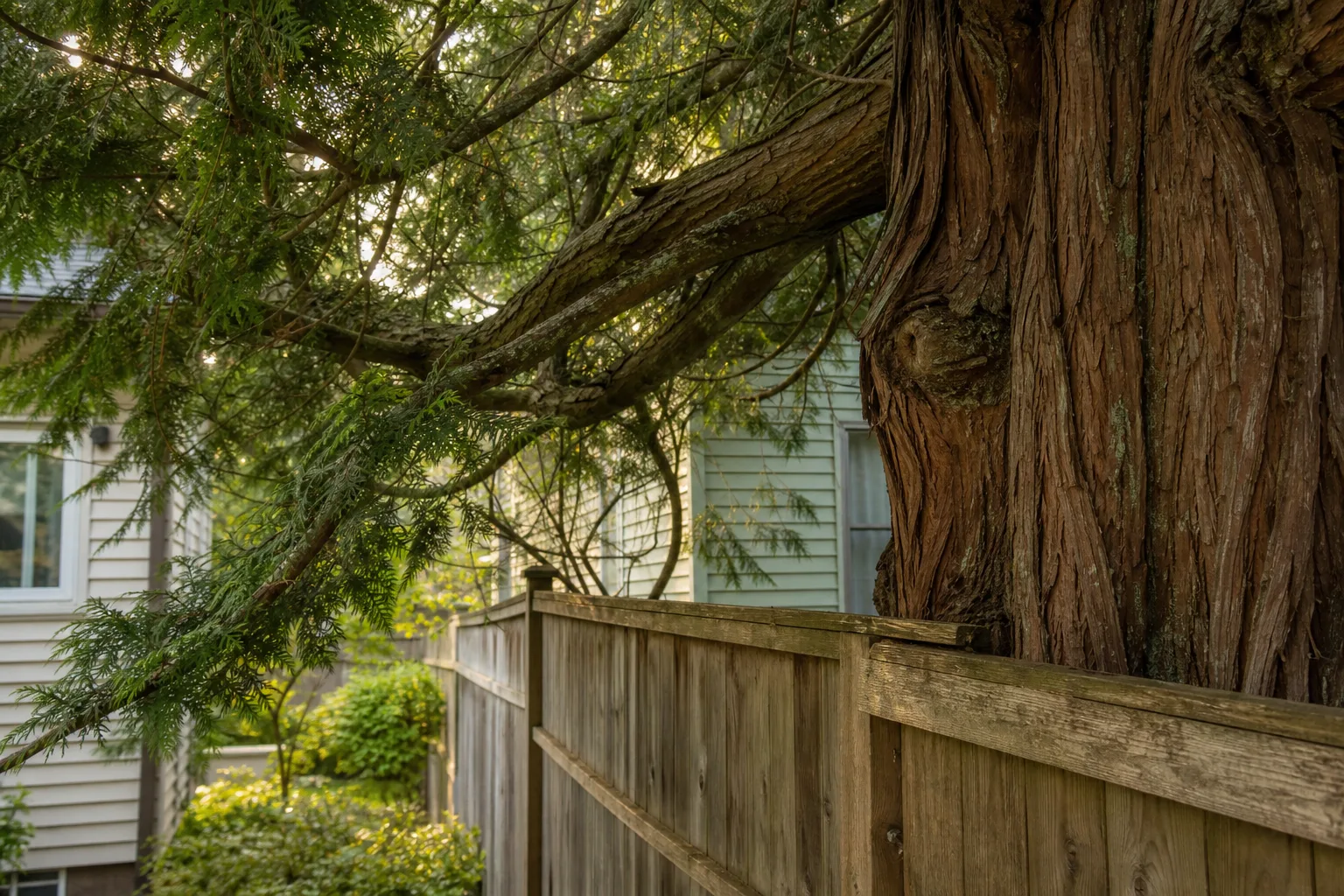
Overhanging limbs, shared roots and protected trees are governed by three separate layers of rule, and the one that stops your saw is usually the local one.
The limb hanging over your side of the fence is governed by three different bodies of rule that were written at three different times, by three different sets of people, none of whom were talking to each other. Old common law decides whether you may cut. State statute decides what happens if you cut too much. A municipal ordinance, often written in the last twenty years, decides whether the tree is protected in the first place and whether a permit is required before anyone touches it. Homeowners get into trouble because they research the first layer, find a clear answer, and act on it.
The self-help rule, and how it hardened into limits
The starting point in most of the country is what courts call self-help. You may cut back branches and roots that cross onto your property, at your own expense, up to the boundary line. That principle is often called the Massachusetts Rule after the case line that made it the default: the encroachment of a healthy tree is not a legal wrong, and the remedy is your own pruning saw, not a lawsuit.
It was a tidy answer for a rural nineteenth century. It aged badly in dense neighborhoods where a mature tree's canopy sits over three lots. Courts started carving out exceptions. Some states adopted what is loosely called the Hawaii Rule, which allows a claim when a neighbor's tree causes actual harm to structures or is imminently dangerous, not merely inconvenient. Others, notably Virginia, moved toward a nuisance test that turns on whether the tree is causing real damage rather than dropping leaves. A handful of states treat a tree whose trunk straddles the line as jointly owned, which means neither owner can remove it alone.
The practical consequence is the part people miss. Self-help gives you a right to cut, but not a right to kill. If your pruning destabilizes or kills the tree, you have moved from lawful trimming into damage to someone else's property, and most states have a timber trespass statute with double or triple damages attached. Those statutes were written to punish log theft. They apply cleanly to a homeowner who took forty percent of a neighbor's Douglas fir canopy in an afternoon.
Then cities added a fourth layer, and it changed the arithmetic
Beginning in the 1990s and accelerating through the 2010s, cities across the West and the Southeast began writing tree protection ordinances. The drivers were canopy loss measured against redevelopment, stormwater management obligations, and heat. The mechanism is usually the same: a size threshold measured as diameter at breast height, a category of specially designated trees, a permit requirement for removal, and a replacement or in-lieu fee schedule.
This is where the geography stops being academic. Seattle's ordinance sorts trees into tiers by size and species, with the largest and rarest specimens protected most tightly, and it requires that certain applications and removals be documented by a credentialed professional rather than by the property owner's opinion. Portland runs its tree code through a separate bureau with its own permit fees and mitigation planting requirements. Atlanta has long used a recompense formula that puts a dollar value on removed canopy. Austin protects heritage trees by species and size, with the Texas oak population getting particular attention.
| What the rule layer decides | Where it comes from | What it costs to get wrong |
|---|---|---|
| May I cut what overhangs my lot? | State common law, refined by case decisions | Usually nothing, if you stop at the line and the tree survives |
| What if the tree dies or the neighbor sues? | State statute on timber trespass and nuisance | Multiplied damages plus the tree's appraised value |
| Is a permit required to remove or heavily prune? | City or county ordinance | Fines, forced replanting, stop-work on a linked project |
| Can I do it at all, given where I live? | Critical area or steep slope overlays, HOA covenants | Restoration orders that outlast the original problem |
Two houses four miles apart can sit under different answers. In much of Seattle, a slope designated as an environmentally critical area triggers a separate review track before the tree code even applies. Cross into an unincorporated part of the county and the ordinance may be looser, or absent, with the state's forest practices rules picking up instead.
What a tree quote is actually assuming
A removal or pruning estimate is a price for labor, equipment, and debris. Read closely, it is also a set of assumptions the writer made and did not ask you to confirm. Whether the tree is on your land at all. Whether a permit is needed and who pulls it. Whether the crane can be sited on the street, which is a separate use permit in many cities. Whether the neighbor has consented in writing to a crew standing on their grass.
Ask the estimator to state, on the page, three things: the permit status of this specific tree, who is responsible for obtaining any permit, and what happens to the price if the city imposes a replanting condition. A firm that works the local code daily will answer without hesitation, because they have already checked. A firm that dodges the question has priced a job that may not be legal to perform, and the cost of that discovery lands on you, not on them.
The credential worth confirming is a certification from the International Society of Arboriculture, which is what most municipal codes point to when they require a professional assessment, and some cities maintain their own registered list on top of it. In Washington, a homeowner deciding between pruning and removal on a protected specimen will typically need a written assessment from a qualified seattle arborist before the permit office will look at the application at all. That report is not a formality. It is the document that decides whether the tree is classified as hazardous, which in turn decides whether removal is permitted and whether replacement planting is required.
Worker safety in tree care is overseen by the Occupational Safety and Health Administration, and it is a fair proxy for how a company runs. Crews that carry proper certificates of insurance, use rigging rather than freefalling limbs over a fence, and set up traffic control on a narrow street are the same crews that read the tree code before they quote.
Sequencing the neighbor conversation
The order matters more than the wording. Establish the boundary first, from a survey or the plat, not from where the fence sits. Then establish who owns the trunk, since ownership follows the trunk in most jurisdictions regardless of where the canopy goes. Then check the city's tree map or permit portal for the parcel before any conversation about money.
Arriving at a neighbor's door with those three facts changes the discussion from a dispute into a shared logistics problem. A common and workable outcome is a split: the owner of the trunk pays for structural work on their side, the neighbor pays for clearance pruning that benefits their roof or driveway, and both sign a short written agreement naming the company, the scope, and the date. Put it in an email if nothing else. A dated record of consent is what prevents a routine job from becoming a claim eighteen months later when the tree drops a limb.
Where a tree is genuinely hazardous, the calculation shifts. Most ordinances contain an emergency or imminent-hazard provision that allows removal first and documentation after, but the documentation still has to exist, and it generally has to come from a credentialed assessor rather than the crew that did the work.
A mature tree on a boundary is one of the few residential assets whose legal status changes depending on which side of a city line it grew on. That is a nuisance to research and a genuine protection once you have. The homeowners who spend a morning on the parcel map and one paid assessment almost always spend less than the ones who started with the saw.