Walking Into a Lawyer's Office Cold? Four Ways to Prepare, and What Each One Costs
title:Walking Into a Lawyer's Office Cold? Four Ways to Prepare, and What Each One Costsauthor:Lionel Karstenspublished:2026-10-21section:Law & Legalwords:1,016read:4 min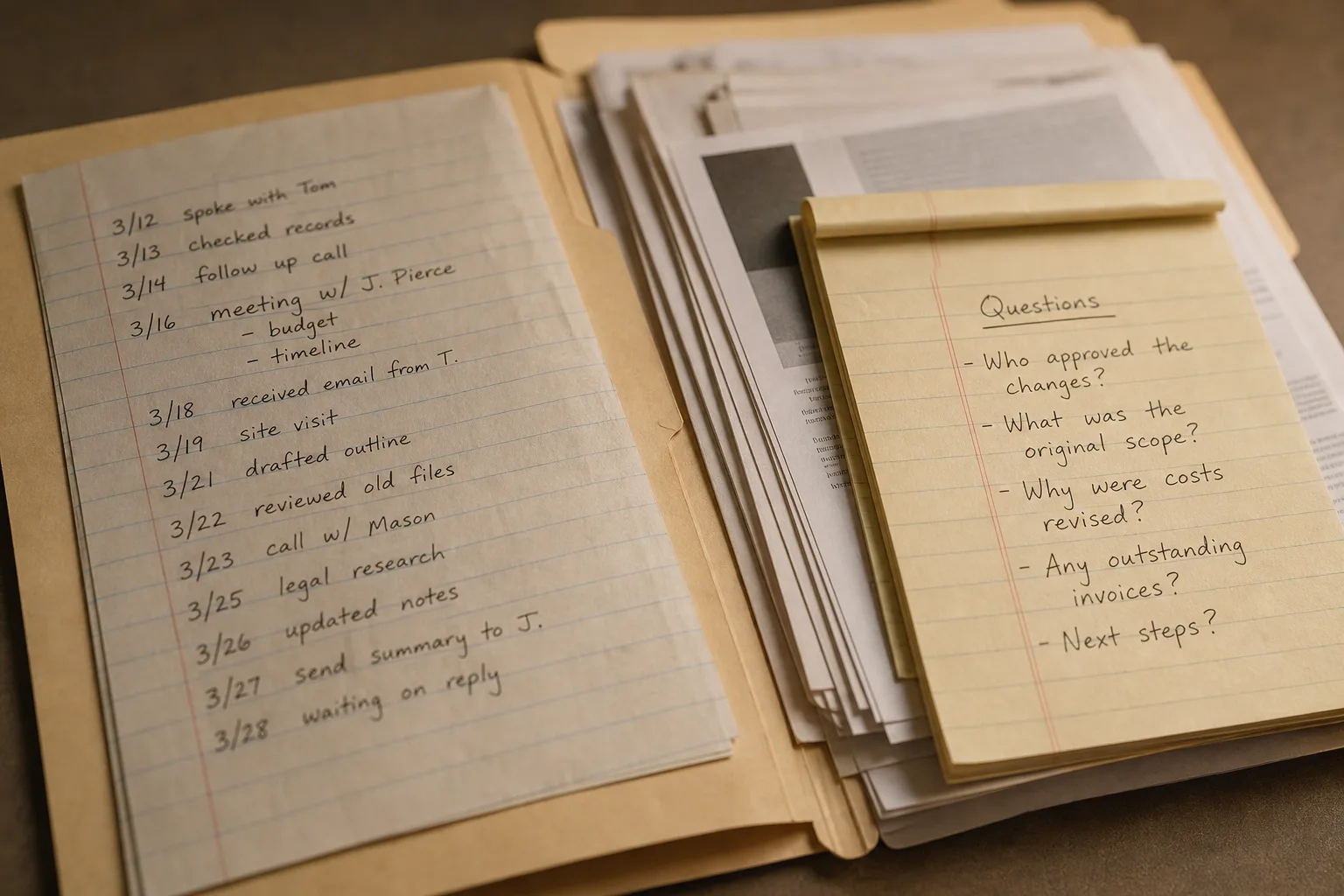
The first consultation is usually free. What it costs is everything you could not answer on the day, so here is what each level of preparation actually buys you.
The consultation is usually free. The expensive part is the twenty minutes of it you spend saying "I think it was a Tuesday" and "I'd have to check." I have sat in on enough of these to know how the hour splits: in a prepared meeting, roughly ten minutes goes to facts and fifty to strategy. In an unprepared one it inverts, and the attorney sends you home with a homework list that delays any decision by two or three weeks. Nobody bills you for that delay. It still costs.
Four ways people show up, side by side
These are not abstract categories. They are the four patterns that come through the door, and each one has a predictable price in money, in your own hours, and in calendar time lost at the back end.
| Approach | Out of pocket | Your time | What it costs later |
|---|---|---|---|
| Arrive cold, tell it from memory | None | One hour | Two to four weeks of back-and-forth before anyone can assess the case; details harden wrong in the retelling |
| Phone intake only, screenshots on your phone | None | Two hours | Attorney gets fragments out of order; dates get reconstructed later from documents you could have pulled first |
| Self-assembled folder: timeline, names, every document you already hold | Copy and printing costs | Four to six hours over a week | Little. Gaps are known gaps, and the attorney can price the work of filling them |
| Folder plus records you had to request (medical, employment, incident reports) | Per-page copy fees, a flat search charge per provider, postage; sometimes unpaid leave to collect in person | Eight to twelve hours over two to four weeks | Almost nothing, but you may have spent money on records the firm could have obtained on your behalf |
The fourth row is where people overspend. Firms handling injury and assault claims on contingency generally request records themselves and advance the cost, recovering it at the end. Paying out of pocket for a full medical file before anyone has told you which dates matter is a common and avoidable expense. The third row is the one I steer people toward.
What actually drives the number
Preparation costs move on four things, and only one of them is the lawyer.
- Fee structure. On an hourly matter, every hour you prepare is an hour you are not paying for. On contingency, preparation does not reduce your fee percentage at all. What it buys instead is a faster yes or no, and an earlier filing date.
- How much lives outside your control. Anything you can print at home is free. Anything held by a hospital, an employer, a police department, or a corporate risk department has a request process, a fee schedule, and a wait.
- How old the incident is. Store camera footage is overwritten on a cycle measured in weeks, sometimes days. Scheduling records, badge logs and staffing rosters get purged on retention schedules. The cost of preparing rises sharply once the free evidence has aged out and has to be reconstructed from witnesses.
- Whether you took unpaid time off. For hourly workers this is often the single largest real cost of the whole preparation phase, and it is the one nobody writes down.
The parts that get skipped when nobody is watching
Everyone brings the paperwork. Here is what gets left out, and what each omission costs on the day.
The dated timeline. One page, one line per event, oldest first, dates and times where you have them and an honest "approximately" where you do not. This is the single highest-value hour you will spend. It also protects you: a timeline written once, early, stays consistent.
Names and roles, not just names. Who was the shift supervisor. Who was the district manager you spoke to. Who took the report and what number was on it. A first name and a shift is enough to find someone later; "the manager" is not.
What you have already said, and to whom. Statements to a police officer, a loss prevention employee, an HR investigator, an insurance adjuster, or a corporate hotline all exist somewhere. The attorney needs to know they exist before, not after. If a company representative has already contacted you, bring the exact wording of what they offered.
Preservation. If footage or logs may still exist, say so in the first five minutes. A preservation letter can go out the same afternoon. That one sentence is worth more than the rest of the folder combined.
The money question, asked out loud. Costs advanced, whether you owe them if the case loses, who pays expert fees, and what happens if you change firms. Ask in the meeting, get it in the written agreement.
Where the specialist firm changes the arithmetic
Retail premises cases against a national chain are not general personal injury. They turn on staffing decisions, prior incidents at that location and nearby stores, lighting and camera placement, and what the corporate security policy required versus what the store actually did. A firm that already knows which corporate records exist will ask for things you would never have thought to collect, which is why attorneys who present themselves as Dollar Tree sexual assault lawyers are describing a body of knowledge about one defendant's internal systems, not just a marketing category. If the incident happened to you while you were on the clock, the workplace safety side runs in parallel, and the Occupational Safety and Health Administration is the federal body responsible for workplace safety standards, including violence prevention in retail settings.
How to spend the week before
Day one: write the timeline. Day two: list every person and every document you know exists, including the ones you cannot get. Day three: print what you already hold, in date order, two copies. Day four: write your questions, the fee questions first. Then stop. Do not spend a dollar on records until someone has told you which records matter.
A folder that takes four hours to build will carry an hour-long meeting all the way to a decision. That is the whole trade, and it is heavily in your favor.