Same Receipts, Two Firms. What a Second Reviewer Catches That a Solo Pass Misses
title:Same Receipts, Two Firms. What a Second Reviewer Catches That a Solo Pass Missesauthor:Beatrix Stapletonpublished:2026-09-09section:Personal Financewords:998read:4 min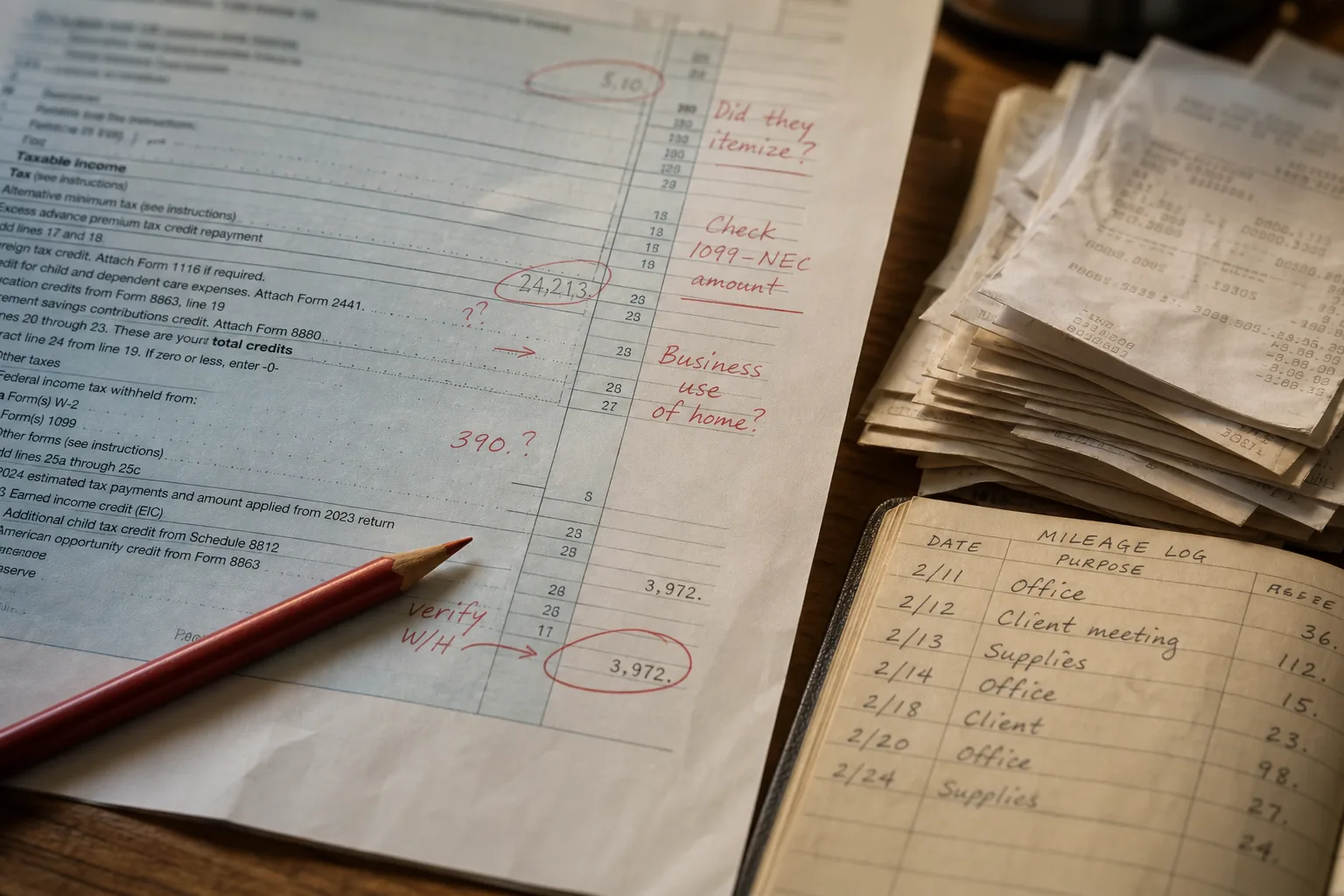
Missed deductions and invented ones usually come from the same gap in process. Here is who is supposed to catch each, and what a review layer actually does.
Two self-employed people can hand over identical stacks of paper and get returns that differ by four figures. Not because one preparer knows a secret. Because one shop has a person whose entire job is to read the return after someone else has finished it, and the other does not.
The gap shows up in both directions. Deductions that were legitimately available never get claimed, because nobody asked the question that would have surfaced them. And deductions that were never available get claimed anyway, because nobody with the standing to say no was in the room. The second kind is the more expensive mistake, and it is the one clients often push for themselves.
Who is actually between your receipts and the filed return
At a small operation, one person does everything: takes the shoebox, keys the numbers, decides the judgment calls, signs. At a larger firm, that work is split, and the split is the point.
- Intake. An administrator or junior staffer runs the organizer, chases missing documents, and flags what changed from last year. A new state, a new vehicle, a first employee, a closed account.
- Preparer. Builds the return and the supporting workpapers. Usually the person who asks you the awkward follow-up questions.
- Reviewer. Reads the return cold against the prior year and against a checklist built for your industry. Sends it back with queries.
- Signer. The credentialed person whose name and PTIN go on the return, and who carries the exposure if the position does not hold.
Ask a firm who fills each of those four slots on your return. If the answer is one name for all four, that is not disqualifying. It does mean the checking is happening inside a single head, on the same afternoon, with the same blind spots.
What gets missed, and why a checklist finds it
Missed expenses are rarely exotic. They are ordinary items that live outside the bank feed, or that require a question the client would never think to volunteer.
| Commonly missed | Why it slips | Who catches it |
|---|---|---|
| Self-employed health insurance | Paid from a personal account, never touches the business ledger | Intake organizer question |
| Retirement plan contribution for the owner | Depends on a computation nobody runs until the return is nearly done | Reviewer, comparing to prior year |
| Startup costs from an earlier year | Incurred before the business had a bank account | First-year onboarding checklist |
| Business share of cell phone and home internet | Client assumes mixed-use means no deduction | Preparer follow-up call |
| Merchant processing and platform fees | Netted out of deposits, so gross revenue and the fee both vanish | Reconciliation of gross receipts to 1099-K |
| Depreciation on equipment bought used or with cash | No invoice in the accounting file | Fixed asset rollforward |
| Mileage for errands, not just client visits | Client only logged the obvious trips | Industry-specific checklist |
Every one of those is a process catch, not a knowledge catch. The preparer who missed the health insurance premium knows perfectly well that it is deductible. Nobody asked.
What gets invented, and who is supposed to say no
The other failure is a preparer who takes instruction. A client says the sedan is a business vehicle, and it goes on the return as a business vehicle. A client calls the spare bedroom an office while the kids do homework in it.
The IRS is responsible for the substantiation and preparer due diligence rules that govern this, and the practical effect is that somebody at the firm has to be willing to lose the argument with you. That is easier when the person saying no is a reviewer who has never met you than when it is the preparer who wants your business next year.
| Frequently invented | What the rule actually requires |
|---|---|
| Commuting mileage | Travel between home and a regular workplace is personal, however far it is |
| Entertainment with clients | Entertainment was removed as a deduction; meals sit under a separate, narrower rule |
| Business clothing | Deductible only if unsuitable for ordinary wear, not merely bought for work |
| The whole home office | Requires regular and exclusive business use of the space, plus a principal-place test |
| Full cell phone bill | Only the business-use portion, and the split needs a basis |
| Family members on payroll | Work must be real, documented, and paid at a defensible rate |
| Education for a new line of work | Deductible when it maintains or improves skills in your current trade, not when it qualifies you for a new one |
The trail that makes a deduction survive a question three years later
A good job leaves a record you could hand to a stranger. That means workpapers that tie each significant line on the return to something outside the return: a bank reconciliation, a mileage log with dates and purposes, a square footage calculation for the office, a memo explaining why a large repair was expensed rather than capitalized.
Barely adequate work produces a return that is arithmetically correct and completely unexplained. It usually holds up fine, right up until someone asks about one number. Then the reconstruction happens under time pressure, from memory, with the original preparer no longer at the firm.
Ask what you get besides the return itself. A depreciation schedule, a carryforward summary, and a short list of items to track differently next year are all signs that the file was built to be reopened.
Three questions that tell you which shop you are in
- Who reviews this before it is signed, and what do they look at? A real answer names a role and a checklist.
- What did you ask me this year that you did not ask me last year? Firms running a live organizer will have specifics.
- What did you decide not to claim, and why? The best answer to this question is a short, unhesitating list.
The last one is the most useful. A preparer who can name three positions they declined is telling you the review layer works, and that the deductions they did take were taken because they hold.