Handed a 40-Page Roof Report and No One to Ask? How to Read It at Your Kitchen Table
title:Handed a 40-Page Roof Report and No One to Ask? How to Read It at Your Kitchen Tableauthor:Lionel Karstenspublished:2026-10-13section:Propertywords:1,073read:5 min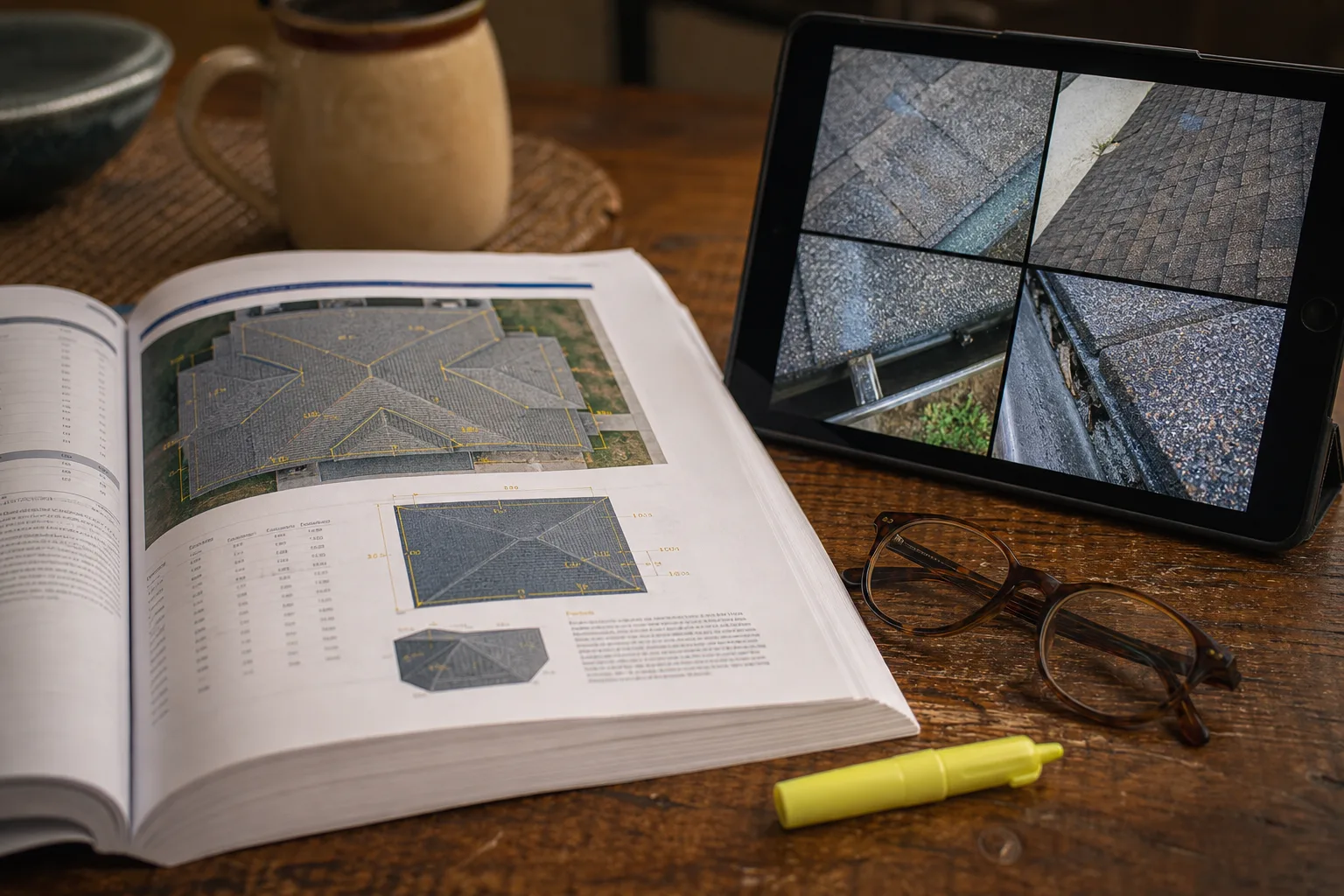
Roof reports turned into photo albums and software estimates in about a decade. Here is how to read one on your own and find the three numbers that decide the job.
Ten years ago a roof inspection ended with a man on your driveway, hat in hand, telling you what he saw. Maybe he had three blurry photos on a flip phone. Mostly he had his word. Now you get a PDF with forty pages, aerial diagrams with every facet measured to the foot, forty-some captioned photographs, and a line-item estimate built in the same software your insurance carrier uses. That is a real improvement. It is also a document most homeowners open, scroll through once, and close without knowing which three pages actually decide what the job costs.
You can read it yourself. You do not need the contractor sitting next to you turning the pages, and there are reasons to do a first pass alone.
Why the report got thick, and what that change was driven by
Three things moved at roughly the same time.
First, fall protection. The Occupational Safety and Health Administration is responsible for the rules that govern working at height, and enforcement around residential roofing tightened over the last decade. Walking a steep slope for a free estimate stopped being a casual thing a salesman did in loafers. Companies started sending a drone or using aerial imagery for the first look and reserving the ladder for the roofs where someone genuinely has to put hands on the shingle.
Second, measurement reports. Aerial measurement services went from novelty to default. The squares, the ridge and hip footage, the valley footage, the rake and eave, the predominant pitch: all of it now arrives as a purchased report before anyone climbs anything. That removed a whole category of argument, and it removed a whole category of guess.
Third, carriers got stricter about documentation. An adjuster used to accept a narrative. Now claims move on photo evidence tied to a diagram, with test squares marked and hits counted. Contractors adapted by producing files that look like claim files, because increasingly that is what they are.
The side effect is that the report you receive was not written for you. It was written to satisfy an adjuster, a supplier, and a production manager. Reading it well means knowing which parts were written for someone else.
Separate the three documents that got stapled together
Almost every modern roof survey is three distinct things in one file.
| Part | What it is | What it is not |
|---|---|---|
| Measurement report | Machine-generated geometry: squares, pitch, linear footage of ridge, hip, valley, eave, rake | An opinion about condition |
| Condition findings and photos | What a human saw, and the evidence for it | A scope of work |
| Estimate or scope | Line items, quantities, waste factor, unit prices | A statement of what is wrong |
The measurement pages are the least arguable and the easiest to check. Square footage divided by 100 gives squares. Compare the total squares on the diagram to the quantity on the estimate's shingle line. They should differ by a waste factor, usually a single-digit to low-teens percentage, higher on a roof with a lot of valleys and cut-up facets. If the estimate quantity is far above the measured quantity with no explanation, that is a question, not an accusation.
Read the photos as evidence, not as decoration
This is where trade habits show. A thorough inspector photographs in a sequence: the full elevation from the ground on each side, then the roof planes from above, then close-ups of anything flagged, then the penetrations, then the attic if access existed. Every close-up should be locatable. A picture of a cracked boot is worth little if you cannot tell which slope it sits on.
Things that should appear in a complete set, and that quietly get skipped when nobody is watching:
- Every penetration. Plumbing boots, furnace and bath exhausts, the chimney, any satellite mount. Boots fail before field shingles do, and they are cheap to address during a reroof and expensive to address alone.
- Flashing at every wall-to-roof junction. Step flashing behind siding is the single most common place a roof leaks while the shingles look fine.
- Valleys, full length. Not one artistic close-up.
- The decking, from inside. An attic photo showing daylight, staining, or spongy sheathing changes the price and should be documented before the tear-off, not discovered during it.
- Gutters and the drip edge. Granule accumulation in the gutter is one of the honest indicators of shingle age.
- Ventilation. Intake at the soffit and exhaust at the ridge. A roof that cannot breathe eats shingles early, and a replacement that ignores it repeats the failure.
If the storm damage sections show marked test squares with hits circled and counted, that set was built to survive an adjuster's review. In a market with real hail and freeze-thaw seasons, that discipline is the norm among established firms doing roofing in columbus, and it is a fair benchmark to hold any report against.
Find the three numbers that decide the job
Strip everything else away and a roof survey resolves to three figures.
- Squares. The size of the job. Everything scales from it.
- Layers and deck condition. One layer or two changes tear-off labor and disposal. Deck replacement is almost always written as an allowance with a per-sheet price. Find that price. Ask how many sheets are assumed, and what happens if the real number is double.
- The accessory package. Underlayment type, ice and water shield coverage at eaves and valleys, drip edge, starter course, ridge cap, pipe boots, ventilation. This is where two quotes on the same house separate by thousands while both say "architectural shingles."
Write those three down for each report you have. Then the comparison is between like things, and the conversation you eventually have with a contractor starts several steps further along.
Mark the file before you call anyone
Go through once with a highlighter and mark three categories: statements of fact you can verify yourself, opinions about condition that carry a recommendation, and anything with a dollar figure attached that is conditional. Then list your questions in the order the pages run. Six specific questions tied to page numbers gets a serious answer. "Can you walk me through this?" gets a sales presentation.
The thickness of these files is a sign the trade got more accountable, not less. Everything that used to live in one man's head is now written down, photographed, measured, and dated, which means a homeowner at a kitchen table with an hour and a highlighter can check almost all of it.