First Denial Letter in the Mail? The Records That Decide Whether Your Appeal Goes Anywhere
title:First Denial Letter in the Mail? The Records That Decide Whether Your Appeal Goes Anywhereauthor:Lionel Karstenspublished:2026-08-27section:Healthwords:1,473read:6 min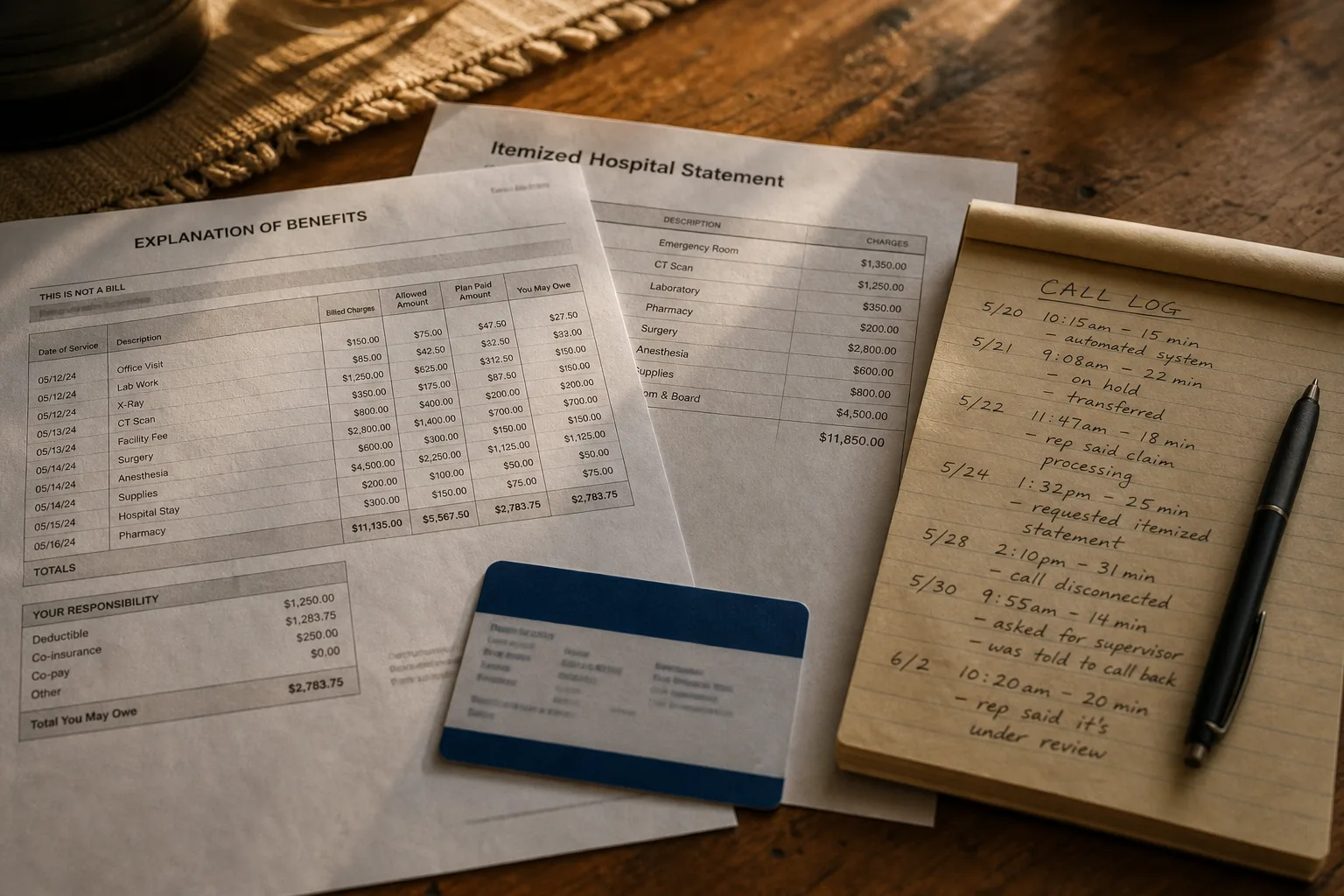
A comparison of the documents worth keeping after a medical visit, what each one proves, and how long it stays useful once a claim is denied.
The denial arrives about six weeks after the visit, on a form that does not look urgent. Somewhere in the middle of it is a code, three or four characters, and a sentence that explains nothing. Most people read it twice, decide it must be a mistake at the insurer's end, and put it on the counter. Four weeks later the provider's bill shows up for the full amount, and now there are two pieces of paper and no obvious connection between them.
That gap is where the money goes. Not because the denial was correct, but because by the time anybody starts working the problem, half the documents that would have settled it in one phone call have been thrown out, deleted, or never collected at all. I spent years on the operations side watching this from the other counter. The claims that got overturned were rarely the ones with the strongest medical argument. They were the ones where somebody had a complete file.
What a denial actually asks you to prove
A denial is not a judgment on whether you needed care. It is a statement that something in the paperwork did not line up. The categories are narrow and they repeat: the service was not covered under the plan, the authorization was missing or expired, the coding did not support the level of service, the patient was not eligible on the date of service, the claim was filed after the deadline, or another payer should have been billed first.
Each of those is answered by a different document. That is the whole point of keeping records, and it is the part first-timers get wrong. People keep the bill, because the bill has a dollar figure on it and feels like the important one. The bill is close to useless in an appeal. It tells you what somebody wants. It does not tell you what was authorized, what was performed, what was coded, or what the plan promised.
The Department of Labor oversees the internal appeal and external review rights that attach to employer-sponsored health plans, and those rights run on a clock. Your file has to be assembled before the clock runs out, which means it has to be assembled before you know you need it.
Comparing the records, and how long each one stays useful
Not every document has the same shelf life. Some go stale the moment the plan year turns over. Others matter for years, usually for reasons that have nothing to do with insurance.
| Record | What it proves | Useful for |
|---|---|---|
| Explanation of Benefits (EOB) | What the insurer allowed, applied to deductible, and denied, with the reason code | At least the length of the appeal window plus a year; longer if it touches a deductible or out-of-pocket accumulator you may need to reconstruct |
| Prior authorization letter or reference number | That approval existed, for which service, and through which dates | Through the authorization's expiry plus the full claim and appeal cycle, often 18 to 24 months |
| Itemized statement from the provider | Line-by-line codes and charges, as opposed to a summary balance | Same as the EOB; also the document that surfaces duplicate charges |
| Insurance card images, front and back, by date | Which plan and member ID were active on the date of service | Keep every version. Coverage changes are the single most common cause of an eligibility denial |
| Referral or order from the referring physician | Medical necessity and the chain that led to the service | Through the appeal, and afterward as part of the clinical record |
| Call log: date, time, name, reference number | What you were told and by whom | The full dispute, and every escalation after it |
| Proof of payment | That you paid, and against which balance | Seven years if an HSA or FSA reimbursement is involved, because that is a tax record |
| Plan documents: summary of benefits, full certificate | What the contract actually says about the disputed service | The plan year plus the appeal window. Download it while you are covered; it can be hard to retrieve after you leave the plan |
The pattern is worth sitting with. The documents with the longest useful life are the ones people least often keep: the authorization number, the call log, the plan certificate. The one everybody keeps, the balance-due bill, expires the moment a corrected claim is filed.
The part that gets skipped when nobody is watching
Here is what happens in practice. You call the insurer, wait twenty-two minutes, and speak to somebody who agrees the denial looks wrong and says they will send it back for reprocessing. You hang up relieved. You write nothing down.
Six weeks later the same denial reissues. You call again, and the second representative has no record of the first conversation, because the note was either never entered or entered on a different member's file. Without a reference number and a date, you are starting over, except now you are four months from the service date and closer to the filing deadline.
The fix takes ninety seconds and no one does it the first time. Every call: date, time, the representative's first name and any agent ID, the call reference number, and one sentence on what was agreed. Ask for the reference number explicitly. They have one for every call. If you do not ask, you will not be given it. That single habit does more for a disputed claim than any letter you will ever write.
The same discipline is why hospitals and large practices staff dedicated teams for healthcare denial management rather than leaving it to whoever answered the phone. Those teams work from a file that gets built as the claim moves, not one assembled in a panic after the rejection. A patient can run a smaller version of the same process, and the mechanics are identical: capture the document at the moment it exists, because retrieving it later costs ten times the effort.
Paper, scan, or portal: which one to actually rely on
First-timers usually pick one system and trust it completely. All three have a specific failure mode.
The insurer's member portal is convenient and it is not yours. Documents roll off, older plan years disappear, and if you change employers or the plan changes carriers, your access can end within weeks. Treat the portal as a source, never as storage.
Paper works and is slow. Its real weakness is that the pieces arrive over months, from four different senders, and a physical file only stays organized if someone maintains it. If you go this route, one folder per episode of care beats one folder per year.
Scanning to your own drive is the strongest option, on one condition: the filenames have to carry the date of service and the patient name. A folder of two hundred files called scan_0042 is not a record system. It is a pile with better lighting. Name the file when you save it, not later.
A workable minimum
For a household handling this for the first time, the smallest system that holds up is a single folder per episode of care, containing: the card image from that date, the authorization number, the itemized statement, every EOB, the call log as a plain text file, and proof of payment. Six items. When a denial comes, you attach the folder to the appeal and you are done in an hour instead of a month.
Where the deadlines actually sit
Two clocks run at once and they are not the same length. The provider has a window to file the claim with the insurer, set by contract, often ninety days to a year from the date of service. You have a separate window to appeal a denial, commonly 180 days from the date on the denial notice for plans subject to federal appeal rules, followed by a shorter window for external review once internal appeals are exhausted.
The consequence people rarely trace back: a bill that sits on the counter for five months has quietly consumed most of an appeal window that started running the day the denial was dated, not the day you opened it. Read the date on the notice first, before the amount. Then work backward.
Once the appeal closes, the records keep earning. An overturned denial that restores several thousand dollars to your out-of-pocket accumulator changes what you owe on every claim for the rest of that plan year, and the EOBs are the only way to prove the accumulator is right. Payment records tied to an HSA belong with your tax file, on the IRS retention timeline rather than the insurer's.
The first denial is the one that teaches the system, and it teaches it expensively. The second one costs an afternoon, because by then the folder already exists and the only new thing in it is the letter.